0
0

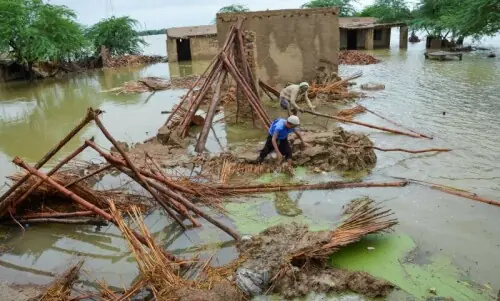
BEFORE the devastation caused by the recent flooding recedes from the minds of the honourable gentlemen at the helm, measures to control floods which may occur within the coming decade should be considered.
In this context it would be worthwhile to take a dispassionate and deeper look at the mothballed Kalabagh dam project which has remained in political limbo since 1987. Now, besides the recurrence of flooding, the annually recurring irrigation water crises (during mid-April to mid-June and October) and the unending shortage of electrical power call for revisiting the Kalabagh dam which is designed for a live (useable) storage of 6.4 million acre-feet (MAF) or 31 per cent less than that of Tarbela dam and for the hydropower generation capacity of 3,600MW matching that of Tarbela.
To begin with we need to carefully look into the major concerns.
Sindh and Balochistan fear that Kalabagh dam would cause a detrimental reduction in the irrigation water supplies.
Sindh also believes that the Indus system does not have surplus water and so it fears that the reservoir would be filled with the waters needed by Sindh and this would transform the province into a desert.
Sindh also fears that with the reduction of water flows down Kotri Barrage the sea would intrude further up into the Indus delta which would cause social and ecological disaster. Moreover, Sindh fears that water from the reservoir would be taken away by the upstream provinces.
It is obvious that the concerns of Sindh and Balochistan essentially stem from the holding up of the waters of the Indus upstream from Sindh. However, in July a consensus between the federal and provincial governments was reached on building the Bhasha dam at a site some 300km upstream of Tarbela. But, since Bhasha will be holding up the waters of the Indus its effect on irrigation water supplies to Sindh and Balochistan and on the ecology of the Indus delta would be more or less the same as that of Kalabagh.
Therefore, what remains out of the list of the concerns voiced against the Kalabagh dam by Sindh and Balochistan is the fear that the dam could allow the upstream provinces to withdraw the waters from the reservoir through high-level tunnel outlets.
However, given that (a) no such outlets are included in the project and (b) the sharing of the reservoir water would be subject to the provisions of the 1991 Water Accord, this issue does not appear to be irresolvable.
Khyber Pakhtunkhwa has opposed Kalabagh primarily due to the apprehension that the back waters of the dam's reservoir pushed up into the Kabul River through the narrow Attock gorge could worsen the flooding in the Peshawar valley.
However, in order to address this apprehension the reservoir conservation level was lowered by 10 feet in the final design of the dam with the result that as confirmed by a state-of-art computer study backed by physical modelling the flood levels in the Peshawar valley will not exceed the historic levels of the 1929 flood of record.
However, in order to address the apprehensions of the province the relevant studies and tests should be redone by an independent international institution acceptable to the government of Khyber Pakhtunkhwa.
It is remarkable that flood levels more or less similar to the historic 1929 levels occurred around Nowshera during the July-August 2010 flood. These levels were caused by the exceptionally high Swat River flows that were superimposed on the high flows of the Kabul River. This suggests that the Munda dam, if it had been built by this time, could have controlled the flood levels around Nowshera.
Again, it is significant that the share of the Swat-Kabul flows in the Indus peak flood discharge at the Kalabagh site on July 31 (820,000 cusecs) was nearly 36 per cent. This indicates that if Munda and Kalabagh dams were there in July-August 2010, the flood peaks would have been shaved off by both and so the extent of flooding in the Peshawar Valley and in the areas downstream from Kalabagh would have been reduced to a sizeable extent.
Now, in reference to the consensus on Bhasha it needs to be pointed out that neither is Kalabagh an alternative to Bhasha nor Bhasha to Kalabagh. Both dams are needed to provide by 2025 a live storage capacity of 18,000MAF (6MAF to replace the loss of the existing capacity due to sedimentation and 12MAF to meet the demand). As to which of the two dams should be built first, the obvious answer is that the first dam should be that which could be completed earlier with less financing.
The status of readiness for undertaking the construction is the key factor in determining which of the two dams could be completed earlier than the other. While the Kalabagh dam was ready to go for international bidding in the late 1980s, Bhasha is still far from that stage. There are still considerable questions about the height of the dam. Some experts have expressed serious apprehensions about the stability of the 890-feet high dam, the highest dam of this type (roller-compacted concrete) ever built.
Besides, there are a number of gaps in the completion of preparatory works. The biggest of these gaps is the difficult, time-consuming and costly upgrading of the 330 miles of the Karakoram Highway (KKH) from Havelian to the dam site. The upgrading work has not yet started.
In comparison, Kalabagh has no unresolved technical issue. As regards access to the site both road and railway line run along the left bank of the river about seven miles from the Kalabagh site. An access road to the site from the existing road has already been constructed. Updating of resettlement plans, environmental impact assessment and project costs are not expected to involve much time-consuming activity. Therefore, Kalabagh dam could be completed in a considerably shorter period of time than Bhasha dam.
Furthermore, the financing requirement for Bhasha would be nearly double that of Kalabagh. The Asian Development Bank's April 2009 mission noted that Bhasha's cost then estimated at $11.34bn could go up to $14-15bn with the inclusion of the missing KKH upgrading and power transmission lines costs. In comparison, Kalabagh's cost, which was estimated at $2.65bn at 1987 prices, could now be $7-8bn.
In the light of the above, Kalabagh clearly qualifies for being undertaken first. However, as suggested, the government should: (a) allay the fear of Sindh and Balochistan about the diversion of waters from the reservoir by the upstream provinces and (b) allay the apprehensions of Khyber Pakhtunkhwa regarding the worsening of the historic flood levels in the Peshawar valley. Further, the Water and Power Development Authority may also be asked to consider reviewing the design of Munda dam with a view to providing a technically feasible flood-retention capacity.
The writer has held senior executive positions in Wapda.