0
0

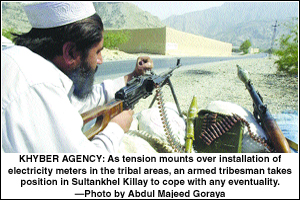 LANDI KOTAL, Sept 13: Tribesmen on Friday got themselves ready to resist an anticipated deployment of paramilitary forces in the midst of a standoff over the installation of Wapda meters in the area.
They brought out their light and heavy weapons, including rockets and anti-aircraft guns, and dag trenches in the Sultankhel area along the international highway linking Pakistan to Afghanistan.
They took up positions in the wake of speculation that the government was going to deploy paramilitary force to protect Wapda’s main towers.
Witnesses said the tribesmen continued patrolling the main road throughout the night to resist any troop deployment. “If they are coming to repair the damaged power lines under the militia’s protection, we wouldn’t let this happen,” an angry man vowed.
They said the tribesmen had cut off water supply to the military cantonment in Landi Kotal from the main reservoir at Ali Masjid.
Electricity supply to Landi Kotal, the border checkpoint at Torkham, Agency Headquarters Hospital at Landi Kotal and the military cantonment remain suspended for the last two weeks.
The government had earlier announced that it would resume power supply to the tribal area for two hours each in the morning and evening to offset water shortage. But tribesmen cut off power cables to register their protest over the meter installation move. “We would rather live without electricity than barter our pride,” a tribal elder said.
A Wapda spokesman said the deadline to cut off electricity to other areas, including Alam Gudar and Sur Qamar in Bara and Jamrud tehsils of Khyber Agency, due to expire on Thursday had been extended by another week following a request by a tribal Jirga.
“We will wait and see how the situation develops till Sept 26,” the spokesman said.
He said the Jirga had sought time to reach an agreement on the installation of meters in the tribal areas.
Wapda says the Federally Administered Tribal Areas owe Rs17 billion to the authority on account of arrears. The bill swelled after Wapda scrapped an old agreement that had allowed electricity consumption at a uniform flat rate and started charging normal tariff applicable elsewhere in the country.
The tribesmen have so far refused to pay the normal tariff, citing social and economic backwardness and the old agreement as reasons.