0
0

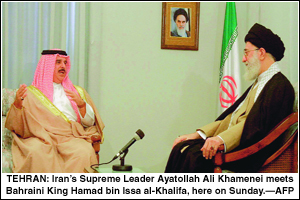 TEHRAN, Aug 18: King Hamad of Bahrain, whose island state hosts the US Fifth Fleet, joined Iranian leaders in opposing any “unilateral” strike against Iraq as he wrapped up a landmark visit to the Islamic republic on Sunday.
“We express our determined opposition to any unilateral military action against Iraq,” said a joint statement issued after King Hamad’s talks with top officials here, including supreme leader Ayatollah Ali Khamenei.
The statement spoke of the two governments’ “shared concern” over the “threats which loom over the region” and voiced opposition to any action that would damage the security and stability of the Gulf.
“The two countries express their solidarity with the Iraqi people and call on the government of Iraq to respect UN resolutions,” the statement said.
King Hamad arrived here Saturday for his first visit to Iran since the 1979 revolution, becoming the third senior official of a pro-Western Gulf state to beat a path to Tehran’s door in the face of US threats of military action against Iraq.
In talks with Foreign Minister Kamal Kharazi on Saturday, he dubbed the situation in the Gulf “extremely serious,” insisting: “We must avoid any action that might spark a war in the region,” Iranian state radio reported.
“We must deprive foreign powers of any pretext to attack Islamic countries,” the radio quoted the king as saying.
“Islamic states must adopt common positions in the face of any crises or external threats.”
In his talks with King Hamad on Sunday, Khamenei took a stronger line than the Gulf monarch, saying Iran was opposed to “any attack against Iraq,” without qualification.
“The (US) propaganda campaign about an attack on Iraq is a flagrant arrogance,” the official IRNA news agency quoted the Iranian leader as saying.
“The Islamic world must take an appropriate position on this issue. There must be the closest links between the Arab states bordering the Persian Gulf and Iran,” he said.
“Given the extreme sensitivity of the Persian Gulf, with its major oil wells and gas fields, any incident in this region will be extremely prejudicial for whoever provokes it.”
King Hamad’s visit capped a slow rapprochement between the two Gulf countries after years of strained relations over Bahraini accusation’s that Shia Iran was fuelling unrest in the island state, where a Sunni royal family governs a mainly Shia population.
The two governments finally exchanged ambassadors in January 1999, although Bahraini Defence Minister Khalifa bin Ahmad Al-Khalifa exposed some simmering tensions last month when he charged that Iran was still supporting fundamentalist movements hostile to the Gulf monarchies.
King Hamad was the third Gulf leader this month to use a visit to Tehran to express misgivings about US military action against Iraq, after Saudi Foreign Minister Saud al-Faisal and top Omani diplomat Yussef bin Alawi bin Abdullah.—AFP