0
0

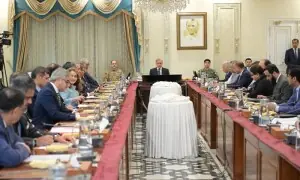
LAHORE, Aug 17: An overwhelming majority of political parties which attended a ‘joint meeting’ sponsored by Pakistan Bar Council, here on Saturday, vowed to scrap the constitutional amendments being proposed by the military government and elect a new president in accordance with the constitutional provisions.
A joint declaration adopted by the meeting also called for resignation or removal of the Chief Election Commissioner to ensure the impartiality and credibility of the October polls. It also demanded an immediate withdrawal of all curbs on political activities to enable the parties and their candidates to launch their election campaign.
PPP, PML(N), Jamaat-i-Islami, Tehrik-i-Insaaf, Muttahida Qaumi Movement, Awami National Party, JUP (Noorani), PDP, Pakistan Awami Tehrik, Jahmoori Watan Party, Pakhtoonkhwa Milli Awami Party and Jiey Sindh Mahaz supported the declaration and voted for it.
The representatives of the Mohajir Qaumi Movement, which favoured the declaration, and of the Millat Party and the PPP (Shaheed Bhutto), expressed reservations and left before voting while the PML (QA) man restrained from giving any opinion about the declaration.
AMENDMENTS:The meeting declared that amending the Constitution was the exclusive function of parliament and no other individual or institution had any authority to arrogate it or change it.
It rejected the presidential referendum held in April and said it conferred no legitimacy on the president.
The meeting condemned ‘the pre-poll rigging being done through changes in the election laws and rules and through frequent transfers and postings of government officials and by use of intelligence agencies.’
It demanded withdrawal of the election orders and ordinances which had virtually amended the Constitution and called for the establishment of an independent and impartial election commission. Elections should be held as scheduled and international observers should not only be allowed but facilitated to perform their job, the declaration said.
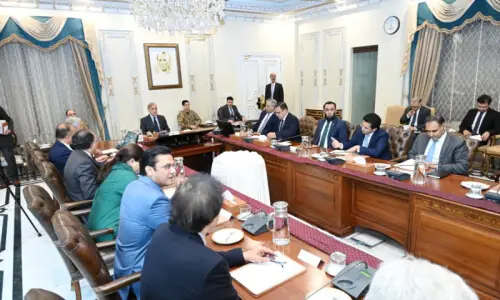
The meeting, held in the Lahore High Court Bar Association’s Shuhada-i-Karachi Hall, lasted for about four hours and was addressed, among others, by Qazi Hussain Ahmad (JI), Dr Mubashir Hasan (PPP-SB), Sardar Assef Ahmed Ali (PML-J), Qasim Zia (PPP), Akram Zaki (PML-N), Sikandar Hayat Malhi (PML-QA), Mairaj Mohammad Khan (TI), Mahmud Khan Achakzai (PKMP), Ehsan Wyne (ANP), Barrister Shahzad Jahangir (Millat Party), Nawab Mirza (Muttahida), K. M. Azhar (JUP-Noorani), Mohammad Nawaz Gondal (PDP), Abdul Khaliq Junejo (JSM), Khadim Husain Qaiser (PAT), Aamar Khan (MQM) and Amanullah Kanrani (JWP).
Pakistan Bar Council vice-chairman Ashraf Wahla, PBC executive committee chairman Haleem Pirzada and Supreme Court Bar Association President Hamid Khan conducted the proceedings and read out the declaration.
SYSTEM:The JI chief read out a representation made to President Pervez Musharraf by Muttahida Majlis-i-Amal leaders. He stuck to it in his one-to-one meeting with the president. It warned the president that constitutional amendments at this stage were misuse of the restricted power conferred on him by the Supreme Court. There should be no departure from the parliamentary system and separate electorate. He said the need of the hour was to mobilize voters and mount a vigorous election campaign.
K. M. Azhar warned that the proposed amendments would convert the form of government into semi-presidential, if not entirely presidential.
Dr Mubashir Hasan said the real issue was not any constitutional amendment but empowerment of the people. Unless the real power was transferred to the people, no law or constitution could prevent military takeovers and civilian misrule. Lawyers and the people at large should not pin hopes on those who served and promoted vested interests. He warned of a ‘widening gulf’ between the citizen and the state.
Sardar Assef said the PML-J supported the campaign against the proposed constitutional amendments. The whole Constitution would revolve round the president and the prime minister would only act as an intermediary between the parliament, the president and the national security council.
Mr Jahangir said Millat Party would consider the amendments on merit and would not blindly reject or accept them. The new parliament should have no objection to amendments made to introduce checks on arbitrary exercise of power. Those who misappropriated public money or indulged in corruption should have no right to contest elections.
POWER TO PEOPLE: Mr Malhi said the PML-QA regarded the people as the source of power but could not close its eyes to realities. He urged the meeting to determine who chained the parliament first. Who got a constitutional amendment adopted within 14 minutes to render the MPs powerless? It was easy to talk in terms of idealism but difficult to practise it. Why political parties made a beeline to register themselves under the new Political Parties Order? He said his party had also made certain compromises in the long-term interest of a workable democracy.
Qasim Zia said his party was proud that all political parties were today fighting for restoration of the 1973 Constitution, which was enacted by a government led by the PPP founder. The PPP got itself registered under the PPO but under protest. There should be no compromise on principles.
Ehsan Wyne said that 1973 Constitution was made by a truncated parliament but his party joined in its enactment in the interest of democracy and federalism. It did not fulfil its promise because of unilateral amendments and under the new system envisaged by the government, even cities and towns would be under direct central rule.
Akram Zaki warned of a constitutional crisis after Oct 12 when the government would lose whatever legal justification it has to rule under the Supreme Court judgment in Zafar Ali Shah’s case. The government was more interested in constitutional amendments than a timely transfer of power, he said.
CIVILIAN SUPREMACY: Mr Achakzai said the basic issue to be settled was that of civilian supremacy. Was Pakistan created for popular government or for military government? Smaller provinces had suffered more on account of frequent imposition of martial law, he added.
Pakistan, he added, was passing through a critical phase of its history and it must be decided once and for all that military would perform the functions assigned to it without dabbling in politics. He appreciated that Lahore, which earlier supported military interventions, was hosting a meeting against a military regime. He said the 1973 Constitution was not the last word and it should be suitably amended to guarantee provincial autonomy.