0
0

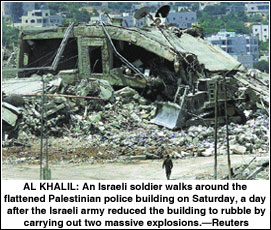 AL KHALIL, June 29: Fifteen wanted Palestinians holed up inside the Al Khalil headquarters of the Palestinian Authority (PA) were killed on Friday night when the Israeli army blew up the huge building after a four-day siege.
However, army sources said no bodies had yet been found in the rubble of the three-storey complex, which had housed administrative and security offices.
The “moqataa” had been under attack since Tuesday, when the army took over Al Khalil, the last of seven West Bank cities occupied in the current Israeli military offensive.
Witnesses said the building had been nearly levelled by charges placed inside and that bulldozers then moved in to finish the job.
The blasts, using two tons of explosives, were so powerful that houses and vehicles several hundred metres away were damaged, their windows blown in.
“There was this unbelievable noise, worse than an earthquake,” said Hayat Maswadeh. “I hid my face under the blanket. When it was over I looked around and saw that my family was safe and sound, so I cried,” she said.
On Saturday, the Israeli bulldozers continued their work, clearing away the rubble, as some of the troops who had taken part in the siege left in trucks, taking photographs of the remains before they went.
The Palestinians inside the building were said to have been local members of “Tanzim”, the Israeli term for fighters linked to Palestinian leader Yasser Arafat’s Fatah organization.
However, a former Palestinian legislator who had entered the complex on Friday in a bid to negotiate a surrender said he had found no one inside, although he had not visited every room of the huge structure.
An Israeli spokesman said the army had authorized “senior Palestinian officials to make direct contacts with the ‘terrorists’ in the building to encourage them to surrender. But the terrorists refused to give themselves up, and the army then decided to destroy the building in a controlled manner”.
The destruction of the “moqataa” was the latest in a long line of Israeli attacks on the infrastructure of Arafat’s government, which is now barely functioning.
Most of the attacks, including strikes by warplanes and helicopter gunships, have targeted buildings of the security services in the West Bank and the Gaza Strip and other symbols of Arafat’s rule.
Arafat’s own “moqataa”, his headquarters in the West Bank town of Ramallah, has also been mostly destroyed, with only the building housing his own offices still standing in the remains of a huge compound.
Arafat aide Nabil Abu Rudeina said, “We strongly denounce this new Israeli crime, which is part of a series of flagrant crimes carried out by (Israeli Prime Minister) Ariel Sharon.”
He said he did not rule out the presence of Palestinians inside the building when the Israeli army flattened it.—AFP