0
0

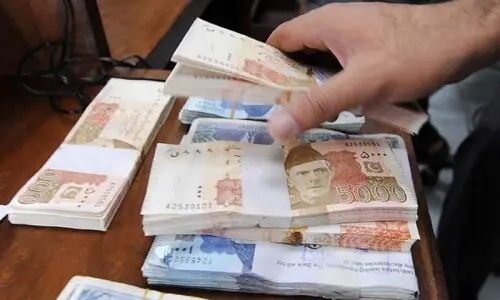
THE RUPEE came under renewed pressure in the inter-bank market on the opening day of the week due to rise in demand for dollar from many banks. It traded at Rs60.16 and Rs60.18 after shedding 6 paisa on April 1, against the previous weekend close of Rs60.10 and Rs60.12.
As dollar demand from foreign banks persisted on April 2, the rupee lost another 2 paisa over the overnight level and traded at Rs60.18 and Rs60.20 against the dollar. However, on April 3, the dollar came under selling pressure, which helped the rupee recover lost ground, gaining 3 paisa on improved dollar supply in inter-bank market. It traded at Rs60.15 and Rs6Q.17 during the day.
On April 4, the rupee managed to hold its overnight level, showing steadier trend at Rs60.15 and Rs60.17. Finally it ended the week almost unchanged, amid lacklustre activity. With only one paisa drop over the overnight level the rupee reverted to the week’s opening day’s level of Rs60.16 and Rs60.18. During the week it, however, reflected 6 paisa fan against the dollar.
On the inter-bank forex counter, the rupee showed strengthened versus the Australian and New Zealand dollars but it weakened against the British pound’ Euro, Japanese yen, Canadian, Hong Kong and Singapore dollars, Swiss franc, Danish and Norwegian krones, Swedish krona, Chinese yuan, Malaysian ringgit, Kuwaiti diner, Saudi and Qatari riyals and the UAE dirham.
In the kerb, the parity remained fluctuated in a narrow bank. After opening the week on a slightly dismal note, shedding 5 paisa against the dollar, the rupee traded at Rs60.25 and Rs60.35 on April 1, against the previous weekend level of Rs60.20 and Rs60.30. It, however recovered 5 paisa on April 2, and traded at Rs60.20 and Rs60.30 on improved dollar supply after there was some hectic selling of dollar.
The parity remained intact on April 3 showing no change over the overnight level, but failing to hold ground on April 4, the rupee shed 5 paisa trading at Rs60.25 and Rs60.35 against the overnight level of Rs60.20 and Rs60.30. On April 5, the rupee again shed 5 paisa in quiet trade against the dollar, which traded at Rs60.30 and Rs60.40 at close. During the week the rupee lost only 10 paisa.
Most currency analysts are of the opinion that with foreign exchange reserves in a comfortable position the current trend in rupee-dollar parity is likely to persist. Dollar supply is sufficient to absorb any rise in dollar.
However, any major demand for dollar in coming weeks is likely to remain absent. In the international financial market the dollar buckled under the weight of heightened tensions in the Middle East on April 1, falling more than one per cent against the European currencies in light of the US trading despite strong US manufacturing data.
Trading volume was thin with the European markets closed for a holiday. Nonetheless, investors were unsettled by the surge over the weekend of conflict between Israelis and Palestinians, which bruised what would normally be a constructive environment for the dollar.
In late US trading, the yen was unable to shrug off the effects of a key business survey felt short of the market’s expectations.
The Japanese currency fell sharply against the euro, trading around 117.40 and off more than 1.40 per cent from its prior US closing level and its weakest since late February.
The dollar found itself tenuously supported near one-month highs, slipping off the session’s peak above 133.80 yen to station itself around 133.40 yen, up 0.50 per cent on the day and off its strongest level since March 4.
The yen skidded across the board in Tokyo, shoved by a disappointing Japanese business survey and signs investors in Japan were shifting some funds offshore.
The dollar showed little hesitation rising as high as 133.38 yen from 132.74 in New York on March 29. Exporter offers and an options defence at 133.50 kept a lid on the currency but dealers said speculators were keen to clear last week’s highs around 133.45 and trip stop-loss buying of dollars for an eventual return to the year’s peaks up at 135.20.
Japanese demand was particularly hot for the Australian dollar, which vaulted to 30month highs on the yen around 71.39 and seven-month peaks on the dotter at $0.535X. The euro benefited, rising to 116.45 yen from 115.68 in pre-weekend trade, and threatening to retest last week’s highs around 117.01). That in turn helped the single currency advance on the dollar at $0.8733 from $0.8715 in New York.
On April 2, the dotter bounced moderately but struggled to regain composure after suffering a blow offshore on raging violence in the Middle East. But overall trade lacked clear direction as dealers kept pondering whether the Middle East tension was more positive for European currencies or the dollar.
The dollar was fetching 133.43/48 yen short of one-month highs of 133.84 hit offshore, but above the 133.15 level where it stood 24 hours earlier. The euro took a step back at 117.29/40 yen from a near two-month high at 117.64 in offshore trade. The euro was subdued at $0.8790/95 after racing to a one-week peak at $0.8822 offshore.
The pound hit a one month high against the euro in London after manufacture, data suggested that Britain continued to outperform the euro zone and consumer credit figures indicated buoyancy on the high streets. The pound pulled back a little later in the day on profit taking and was quoted at 61.17 pence per euro.
The dollar bounced back in New York from one-week lows against the euro and the safe haven Swiss franc a day earlier, as European data suggested euro zone economic activity was lagging that of the United States. Escalating Middle East tensions had sparked a broad sell-off in the greenback in holiday-thinned markets and, while the conflict shows no signs of improving, analysts said the dollar found some support from indications the US economy would outperform Europe. The yen, meanwhile, remained under pressure. The greenback was modestly firmer on the day, around 133.50 yen, not far from one-month highs of 133.83 yen. The euro was around 117.40 yen in early US trading within sight of previous day’s 1-1/2 month peak of 117.66.
On April 3, a surge in Japanese stocks gave a lift to the yen, which rose half a per cent against both the dollar and euro despite market expectations that investment outflows would lead to a weaker currency. The dollar’s demand was soured as a result. The greenback ended US trading at 132.65 yen, below the 1-month highs reached earlier this week at 133.84 yen. The euro was also lower against the yen, trading near 116.80 yen.
In Tokyo, the dollar ceded some ground to the yen as bulls lost patience with an absence of heavy Japanese buying at the start of the new business year. The market has yet to see an anticipated flood of Japanese money abroad in the first few days of the New York this month, leaving speculators feeling vulnerable with a recent heavy build-up in dollar positions.
The dollar was limp near the day’s lows at 132.69/74 yen by late afternoon in Tokyo, having come off an offshore high of 133.62 on a triggering of several stop-loss levels. The yen was also encouraged by a rise in Tokyo’s Nikkei stock average, which got a suspected boost from public pension fund inflows. The euro drifted lower at $0.8784/86 in Tokyo from $0.8791 in New York, though managing to avoid stop-loss orders at $0.8770. The single currency likewise slipped on the yen at 116.55/67 yen from 117.25 with the move exaggerated by a break of key support at 116.80.
In London, sterling ended little changed against the dollar and the euro as the market settled in to wait for this week’s Bank of England interest rate announcement even though no change was expected. Sterling was trading at 61.24 pence per euro, pretty much where it was at the end of play in New York on April 2 but around a quarter of penny off one-month highs set earlier in that session. It also fetched $1.4377; again little changed on the day, but around half a cent off 2-1/2 month high set on April 1.
On April 4, the dollar succumbed to the yen for a third straight session in Tokyo, rotted by options-related trade that sparked selling by Japanese exporters. After a sprightly start, the dollar strode to as high as 133.15 yen on options-led trade in early Asia from 132.74 in New York and offshore lows of around 132.37. But selling from exporters and profit-takers knocked it back to 132.40/50 yen. The dollar has meandered in a range since a bounce from a three-month low of around 126 in early March, with its ascent capped by the recent rise of violence in the Middle East.
The euro gave up ground at 116.67/78 yen from 116.87 in late offshore, still under profit- taking pressure after climbing to a near two-month high earlier in the week. Against the dollar, the single currency steadied ahead of a rate-setting meeting at the European Central bank (ECB), at $0.8810/15 from $0.8803 in late New York.