



 0
0

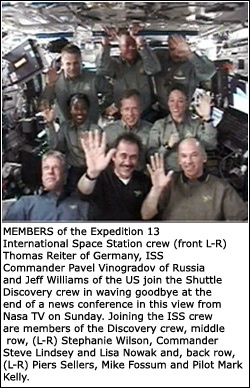 HOUSTON, July 9: Astronauts on shuttle Discovery expressed confidence in their spacecraft on Sunday after Nasa engineers said problems found since last week’s launch appear minor enough to withstand the rigors of landing.
In an e-mail message to the shuttle crew, they said most blemishes found in post-takeoff inspections did not pose a danger to Discovery and they expected a few lingering safety issues to be declared safe as well.
“We’ve been told we have a very clean vehicle. I certainly have no concerns about returning,” mission specialist Stephanie Wilson said in a news conference from space.
“I hope it comes out okay and I think it’s going to,” said flight commander Steve Lindsey. “To get a clean vehicle or a win, I think, is really exciting.”
A steady stream of good news about Discovery’s condition has given Nasa growing confidence that its $1.3 billion safety upgrade of the shuttles following the 2003 Columbia disaster is a success.
This flight was viewed by many in the US space agency as a make-or-break mission for the troubled shuttle programme, which is critical to finishing the half-completed $100 billion space station.
One lingering concern focuses on a couple of ceramic cloth ‘gap fillers’ sticking out from between heat shield tiles.
Nasa managers said one has been judged safe and the other is under study, but ‘it is expected that this will be cleared’ upon final analysis.
The same was true for minor damage to protective thermal blankets on the spacecraft.
“Both of these items are very close to be cleared as safe for entry,” the e-mail said.
If it turns out that there is a problem of note, astronauts Piers Sellers and Michael Fossum could attempt to fix it while spacewalking next week ahead of landing on July 17.
Sunday’s e-mail message said marks that showed up on photos and sensor inspections of the shuttle’s wing and nose areas turned out to be nothing worse than possible bird droppings.
The shuttle Columbia broke apart as it descended toward Florida on February 1, 2003 because of a hole punched in its wing heat shield at launch by insulating foam that shook loose from the fuel tank.
Hot gases entered the breach during its fiery descent through the atmosphere, which destroyed the spacecraft and killed the seven astronauts on board.
Despite modifications to the tank, foam broke loose on the first post-Colombia shuttle flight last summer, but did no harm.—Reuters




























