0
0

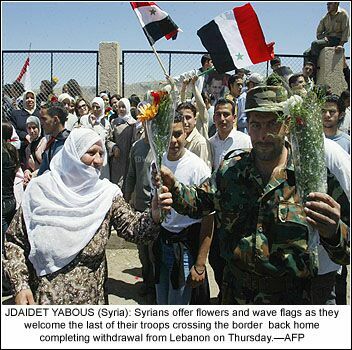 RIYYAK, April 26: The last Syrian soldiers and intelligence agents left Lebanon on Tuesday, ending three decades of Syria’s direct involvement in its small neighbour.
As their buses crossed the frontier, many Lebanese hailed the completion of a withdrawal that had taken seven weeks as the start of a new era. But although Damascus’s domination is past, many believe its influence in Lebanon is far from over.
“With the completion of the Syrian forces’ withdrawal from Lebanon, a new political era in the relations between the two brethren countries starts based on close cooperation in all fields,” Lebanon’s new Prime Minister Najib Mikati said.
Syrian forces entered Lebanon in 1976 to try to end a civil war that had begun the previous year. It was not until 1990, however, that the conflict ended; Syrian forces had fought variously against Muslim and Christian militias, Lebanese army units, Palestinian guerillas and the Israeli army.
Pro-Syrian Lebanese officials say 12,000 Syrian soldiers were killed in Lebanon and many more wounded.
Syrian forces and intelligence had dominated Lebanon since the civil war — until a UN Security Council resolution last September demanded a total withdrawal.
The Feb 14 assassination of former Lebanese prime minister Rafik al Hariri triggered anti-Syrian protests in Beirut and piled the pressure on Syria to quit.
“We are very happy, we are celebrating,” Khaled Saleh, 24, a computer consultant, said. “I have been asking for this all my life.” A score of young Lebanese males performed a traditional dance in celebration as the Syrians were leaving.
Analysts say the withdrawal will end Syria’s domination of Lebanon but would not end its influence altogether.
“Definitely there will be a reduction in Syrian involvement in internal Lebanese affairs, they will no longer select high-ranking officials,” Samir Baroudi, a political scientist at Beirut’s Lebanese American University, said.
“There will continue to be high-level coordination between the two countries as far as bilateral economic relations and the overall peace process in the Middle East.”—Reuters