0
0

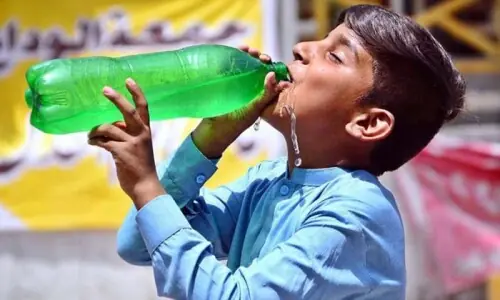
KARACHI, Nov 16: The Dabla village, inhibiting people shifted from the Indus Delta after the decay of the ecosystem there, is facing a shortage of water , and lacks healthcare and education facilities for the last 60 years.
These people had left their ancestral villages - in the coastal area of district Thatta - long before partition due to the decaying ecosystem and increasing sea erosion, which was the result of construction of barrages in Punjab.
The community, comprising 1,700 people, traditionally depends on fishing.
The village has a water supply line but is without water. "I have personally approached the nazims of Bin Qasim Town and Union Council Rehri to get the water and sewerage problems solved, but despite their assurances, no practical step has been taken so far," Akhtar Shaikh, area activist and councillor of Rehri UC told PPI.
"Shortage of water is a major problem for people living in makeshift homes on the seashore.
"Furthermore, villagers need earth-filling on the shore to save their homes from water accumulating at the low-lying areas due to the frequent high tides," said Shaikh.
The UC has approved to build six pit-latrines on the seashore to facilitate fishermen. But the problem still needs to be reviewed, as the place identified by the authorities for constructing latrines is unsuitable. The villagers opined that latrines would come under water due to high tides and the filth would be swept into their homes.
Mohammed Gabol, an office-bearer of the Pakistan Fisherfolk Forum said that the UC Nazim and a team of the Bin Qasim Town had visited the village several times, but practical steps were yet awaited.
They have also been demanding the construction of a jetty, as fishermen have to land their catch at a long distance from their homes in the absence of the facility.
"We have sent several applications to the concerned authorities of the city government, town and UC but all have gone unheeded."
Nawaz Dablo, the village's activist, while sharing his experience said that the Fishermen Cooperative Society had constructed a small stonewall on the seashore several years back. Despite that, the seawater gushes during high tides. The problem is that there is no arrangement for the discharge of water. And especially in rainy seasons, it is difficult for women to cook meals in their courtyards, as their homes are inundated by water for having no outlet for discharge.
The locality has been yet unable to produce even a single matriculate, because of the isolated location of the village having no school. Moreover, not even a single government-run healthcare centre is available to treat people. - PPI