0
0

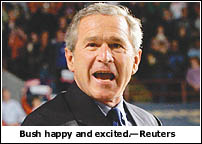
WASHINGTON, Nov 3: Voters across the United States on Tuesday gave President George W. Bush a second mandate to continue the war against terror as he did in his first term , pushing aside speculations that problems in Iraq may force Americans to change their leadership midstream.
The voting pattern also showed that the Americans have continued their march to the right, giving Republicans control over both houses of Congress.
It was predicted from the beginning that if the images of 9/11 still haunt Americans, they will vote for Mr Bush, but if pictures from Iraq have had a greater impact, Sen Kerry will win. And the election results proved that those who said 9/11 was going to be a deciding factor in the 2004 elections, they were right.
Similar to a situation four years ago, the 2004 election also ended in a dispute when Senator Kerry refused to accept the results from Ohio, a key battleground state where this year's presidential battle was finally decided. But in contrast, the controversy did not continue for weeks. At 11am Washington time (0900pm PST), Sen Kerry telephoned President Bush at the White House and conceded defeat.
According to a White House statement, Mr Bush called Mr Kerry "an honourable and worthy opponent". Mr Kerry told him that "today the nation is divided and Mr Bush agreed", said a Kerry spokesman.
In Ohio, Mr Bush received 2,794,346 votes while Mr Kerry polled 2,658,125 votes. This gave Mr Bush a lead of more than 136,000 votes. The Democrats, however, said 250,000 provisional votes had not yet been counted. Later, it turned out that there were only 135,000 provisional votes, out of which 13,000 went to Mr Bush and 6,000 to Sen Kerry as the counting began. At this stage the Kerry campaigners decided to concede.
White House Chief of Staff Andrew Card came to Washington's Ronald Reagan Center at 6am (0400pm PST) and told thousands of supporters: "The president carried Ohio by a statistically insurmountable number of votes and has won re-election by a decisive margin," signalling the celebrations to begin even before Mr Kerry had conceded defeat.
Needing 270 electoral votes to become president, by midnight Mr. Bush was held up at 254 with Ohio (20), Iowa (7) and New Mexico (5) yet to be decided. Mr Bush had swept 28 states for his 254 electoral votes. Sen Kerry took 19 states and the District of Columbia to bag 252 electoral votes. Nationwide, Mr Bush won about 3.5 million more popular votes than Kerry, reversing his 2000 loss to Al Gore on this count.
But electoral votes, determine who will be president, As such Mr Bush had to win Ohio to reach 270. Iowa and New Mexico do not have sufficient electoral votes to carry him to the mark.
Mr Bush's victory was based almost entirely on massive support for the Republican Party from the mostly conservative American heartland.
The Democrats retained the western states of California, Oregon and Washington State and won the entire North East and most of the upper Midwest states. But that was not enough to take Sen Kerry to 270.