0
0

ISLAMABAD, July 24: Under the first draft of a package of "framework" agreements for completion of Doha Development Agenda (DDA), the developing countries, including Pakistan , will have a longer implementation periods and lesser tariff reduction on agriculture produce, access to special products (SPs) and a special safeguard mechanism (SSM).
The long-awaited document or framework for the DDA will be accepted or rejected by 147-member General Council meeting scheduled for July 27-29 at Geneva.
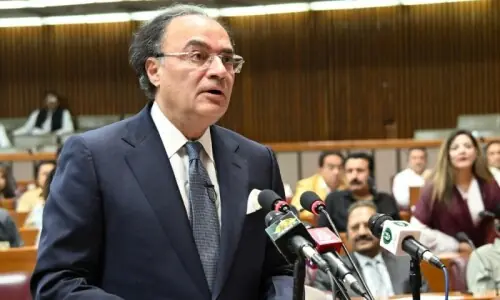
Federal Commerce Minister Humayun Akhtar Khan will represent Pakistan in the meeting with secretary commerce Tasneem Noorani and Pakistan's ambassador to WTO Dr. Manzoor Ahmed as members of his team.
Official sources told Dawn on Wednesday that Pakistan's bound rates (a level beyond that current customs duty could not be raised) on agriculture were 100 to 150 per cent. With these principles agreed in the document, would mean that Pakistan's bound tariff rates could stay well over the current applied rates (current customs duty). "Moreover, since we could designate our sensitive products such as sugar, wheat, edible oils, etc., as 'SPs,' we can continue to have higher tariff protection than at present," they said.
The framework document, a copy of which was made available to Dawn, showed that the document focused on three main issues - agriculture, non-agricultural goods, and trade facilitation - as the single Singapore Issue.
On agriculture, in the domestic support, it was envisaged that a higher level of domestic subsidies would be subject to deeper cuts. This was a key demand by the US as it asserted that the European Union (EU) was paying three times more subsidies and should make deeper cuts. However, each WTO member is being required to make substantial overall cuts.
While the demand of G-20 and other developing countries for substantial cuts has been accepted in principle, their demand for cutting subsidies from the present applied level has not been included in the draft text. Therefore, the subsidy level of the EU might not be subjected to any real cuts in near future.
Another G-20 demand, to have greater disciplines on Green Box subsidies, has been acknowledged. Green Box criteria will be reviewed after July.
The biggest victory for G-20 countries is to have the concept of an end date for elimination of export subsidies and to bring export credits of the US under discipline. On market access also, the framework envisages 'tiered formula'. It means that higher duty rates would have to be cut by a higher degree. It may be noted that the US and EU were insisting on a blended formula. That could have meant that most products with higher protection would have escaped any reduction commitment.
For industrial goods, the basic draft was the same as was presented at Cancun ministerial conference in September 2003 and was known as the Derbez text. This text was considered by developed countries as not ambitious enough.
On the other hand, developing countries are not willing to accept any sectoral elimination of tariffs even for sectors such as textiles/clothing where they have a comparative advantage. Least Developed Countries (LDCs) have been given the flexibility of not affixing any tariff cuts provided they increase their bindings.
Because of special and differential treatment, developing countries can protect their sensitive sectors either by applying half of formula cuts for 10 per cent of tariff lines or not applying an cuts for 5pc of tariff lines.
For Singapore Issues, it has been agreed that one of the four issues - investment, government procurement and competition policy - there would not be any negotiations during the current Doha Round. Only negotiations on Trade Facilitation will be dealt with. On the insistence of developing countries, it has been agreed that any eventual agreement would take into account their implementation capacity.
Overall, the framework includes most of the elements of G-20 countries for agriculture. Sufficient flexibility has been built into the framework so that developing countries could keep higher tariffs on sensitive products.
Regarding the Singapore Issues, demand of developing countries to negotiate only one subject has been acceded to. Although the other three have not been dropped from the WTO Agenda, they will not be included in the current round of negotiations.
Analysts said that it was not clear how LDCs and other G-90 countries would react to these proposals. However, most other developing countries and developed countries were likely to accept these proposals.