0
0

The divergent perceptions about the ongoing development process have created hopes, doubts, jubilation and frustrations in Balochistan.
The two contending schools of thought comprising those of nationalists and the progressives/liberals maintain two different views in this regard.
The nationalist groups/parties have serious reservations about the ongoing process of economic development. They base their judgement on historical realities and the post-independence policies of discrimination of the decision-makers in Islamabad vis-a-vis the development of Balochistan.
Nationalists argue that the primary beneficiaries of the ongoing mega projects in the province would be the non-locals and aliens, and they fear that the government could use the pretext of backwardness of the people to justify appointments of aliens in these projects. For the past five decades, Balochistan received no significant investment whether foreign or domestic.
They say if the development is a pressing need of time, vast potentials in all sectors of this province should be developed. The future of Pakistan is incontrovertibly linked to the economic development of the province. The strategic location of Balochistan gives it added significance in view of rapidly changing geo-politics of the region.
They also claim that in the Saindak copper project, Balochistan's interest has been jeopardized as Chinese share is 74 per cent whereas the federal government has 25 per cent and the province only one per cent.
The liberals/progressives view the process of economic development in a pragmatic perspective, supporting Islamabad's present policy. They hail the government's development packages as a compensation for the injustices done to the province in the past.
After a five-decade period of negligence, discrimination and indifference, the province is on the top of a development agenda and at least six mega development projects are under execution, besides a number of small projects.
Liberals argue that the total income of the province is about Rs1.58 billion which makes it mostly dependent upon the resources received from federal gvernment through the National Finance Commission (NFC).
The province receives about Rs24.7 billion under the NFC award on the basis of population which is not sufficient for carrying out development process in the largest province of the country. Balochistan also needs financial co-operation from international donors and foreign investors to bring the province at par with other provinces.
Undeniably, Balochistan has suffered long years of neglect. What precisely are Balohistan's problems? The province is mired in poverty. In terms of literacy, higher education, technological development, healthcare, infrastructure development and industrialization, the province is far behind rest of the country.
The process of economic development in Balochistan began in 1970 when it got the status of fourth province of Pakistan. In the initial phase, which culminated in 1977, the short-term planning or one-year plan or annual development program was followed to develop the resources of the province.
At that time, the province absolutely lacked the physical and institutional infrastructure for governance. So in the initial phase, efforts were directed and investment made to create such an infrastructure.
The second phase of economic development of the province witnessed long-term planning on the basis of five-year pland. This phase culminated in October 1999. During the two phases, lack of financial resources, inefficiency, corruption and a weak approach of the economic planners and managers proved to be the main hurdles that retarded the process of economic development. The decision-makers in Islamabad showed no interest toward development of the enormous untapped resources of the province.
The NFC Award failed to provide enough resources for this least developed province, under the distribution formula based on population. The most populous regions, under current scheme of the things, are being developed at the expense of least populous regions. From a reverse angle, another subvention for low growth of population should be awarded to the provinces and funds should be slashed for high growth of population.
Nationalists contend that the federal government earns annually Rs84 billions from Sui gas fields, but Balochistan receives only Rs5 billion as the development surcharge and excise royalty. That is a great injustice. The gas development surcharge (GDS) is the only major source of income for this province.
The province received Rs17 billion during FY 2003-04, same as in FY 2002-03, while there was an increase of 11 per cent revenue of federal and three provincial governments under this head. Clearly, it is political dominance which inluences official decisions in economic planning and policy-making. Balochistan remains the most voiceless and hence the most-neglected province.
The main cities such as Quetta, Sibi, Chaghi, Loralai, Kila Saifullah, Turbat, Kalat, Khuzdar etc. are far behind in socio-economic development than any main city in other provinces. There is no infrastructure, no industry, no viable road network, no agriculture extension services and no technical training centres and quality education institutions in the province.
Now a paradigm shift in Islamabad's policy vis-à-vis development of the province is visible and various projects have been launched during the last three years costing Rs120 billion.
At present, the Kachhi canal, Mirani Dam, Gwadar deep-sea port, Mekran coastal Highway, Saindak copper and gold project and Quetta water supply scheme are the mega projects in execution stage which are expected to bring prosperity into the province.
The federal government increased allocation of funds for the development of the province by 300 per cent in the federal budget for FY 2003-2004. Priority has been given priority in the budget allocations to the development of water, infrastructure, health and education.
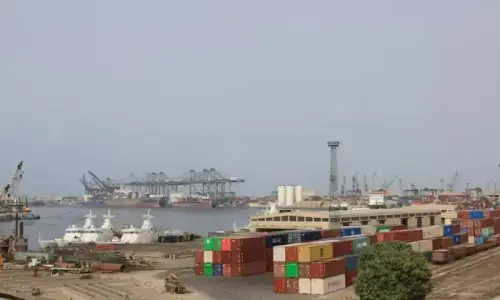
The province has the potential to emerge as a regional hub of economic activities. The most important project is Gwadar as a free port which could become a mother-port in the region by virtue of its strategic location. Its first phase will become functional in next few months.
But security environment is marred by the prevailing sense of deprivation and frustration among the masses. If the people have some reservations about the developments taking place on their soil, these should be removed. There is a need to address the local population's real grievance vis-à-vis ongoing mega projects.
Programmes for the development of human resources should be launched on war footings. All issues regarding protection of vital installations must be resolved through democratic means.
The talk of a military operation will be counter-productive. Balochistan needs an economic revival operation instead of a military operation in the given "take off" situation of the national economy. The situation demands peace, harmony and a stable law and order situation.