0
0

KABUL: Every evening, minibuses pour into Kabul in their hundreds. But the Afghan refugees who have spent four days returning from Iran speak of leaving reluctantly and being "sharply encouraged" by Tehran.
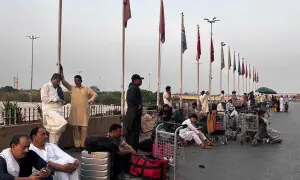
In a UN High Commissioner for Refugees (UNHCR) centre near the airport, women draped in Iranian-style black veils wait with their husbands for the 18-dollar-per-person handouts given to new arrivals.
Others examine a public information display about landmines, with which the country is infested. Their tired faces are devoid of joy. More than one million of these Afghan refugees have returned from Iran since April 2002, the UNHCR said last month. In recent weeks, there have been almost 4,000 a day.
"Any kilometre you are coming into you think that you are going 10 years backward. I could not even imagine," said Jawad, who has spent 22 of his 23 years in the Iranian capital.
His sister Fatima, 32, added: "There is dust, there is no sanitation, kids get sick. I did not imagine this was this much destroyed." Squatting in the shadow of the wall around the centre, Fatima described her "normal" life in Iran with an Afghan husband, a peasant who grew "tomatoes and aubergines".
But things changed. "Our men in the family would be bothered by police and arrested. Our kids could not go to school because we had to pay" a special fee for Afghans, she said.
They wanted to stay because of the problems in Afghanistan, but were unable to. "On radio and TV they said Afghan refugees should go back because we also have an unemployment problem. They would say that we could face legal action and police would arrest people and threaten to punish them."
A 48-year-old widow sitting nearby, also called Fatima, said: "Now we are here, we came here and we don't have any house. We have come back to Afghanistan and we have nothing."
Some refugees manage to stay with their parents who remained in Afghanistan, but all of them complain of the lack of work and places to live. However, Afghanistan's planning minister, Ramazan Bachardoust, said Iran, his own country's government and UNHCR were all to blame for the problem. "We promise them mountains and marvels, and when they arrive, it's absolute misery," he said. -AFP