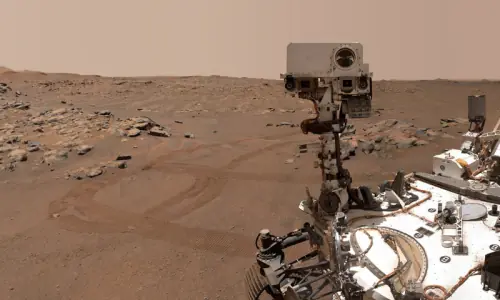
WASHINGTON, March 23: Nasa's Mars rover Opportunity is parked by the shore of what used to be a salty martian sea, scientists reported on Tuesday. "We think Opportunity is now parked on what was once the shoreline of a salty sea on Mars," said Steve Squyres, principal investigator for the science payload on Opportunity and its twin Mars exploration Rover, Spirit.
Scientists have long seen signs of liquid water on Mars, and the rovers' mission was to investigate areas believed to have been covered with water long ago. If there was water, theorists believe, there might have been life on the Red Planet, Earth's next-door neighbour.
This is the first time, though, that scientists have concrete evidence - new data from the rovers' analysis of the Mars rocks themselves - that water might have flowed on the martian surface.
"This dramatic confirmation of standing water in Mars' history builds on a progression of discoveries about that most Earthlike of alien planets," said Ed Weiler, Nasa associate administrator for space science.
"This result gives us impetus to expand our ambitious programme of exploring Mars to learn whether microbes have ever lived there and, ultimately, whether we can," Weiler said in a statement.
The Mars rovers can do more than take pictures and beam them back to Earth. They also carry three different scientific instruments that can analyze the composition of various rocks and a grinding tool that can drill down under the surface.
Opportunity has been roving across the seemingly barren martian surface since January and is now working with rocks that were once covered with a rippling saltwater sea, the scientists said.
Opportunity's controllers plan to send it out across a plain toward a thicker exposure of rocks in the wall of a crater to see if they can find more evidence of standing water.
So far, scientists point to patterns in some finely layered rocks that indicate they were shaped by ripples of water at least 2 inches (5 cm) deep and possibly much deeper. This water was flowing at a speed of 4 to 20 inches (10 to 50 cm) per second, according to John Grotzinger, a member of the rover's science team. -Reuters