0
0

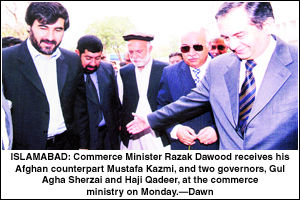 ISLAMABAD, May 13: Islamabad has turned down a Kabul’s proposal to allow transportation of Indian goods to Afghanistan through the Wagah border, but indicated to open the Khunjrab Pass for Chinese consignments, authentic sources told Dawn.
An official who had attended the Pakistan-Afghan talks here at the commerce ministry, said the Afghan commerce minister kept on insisting that Wagah border should be opened for the transportation of Indian goods to Afghanistan. But, his counterpart Razak Dawood responded that it was not possible under the given circumstances, particularly because of the Indian attitude, notwithstanding the heartiest Pakistani desire to help Afghanistan in every field of life.
When this reporter sought comments from the minister of state and chairman of the Export Promotion Bureau, Tariq Ikram, he said: “We have no objection if Afghan goods are transported through the Wagah border to India”.
On the transportation of Indian goods to Afghanistan, Mr Ikram said it was dependent on the resolution of Kashmir and other issues.
Commerce Minister Razak Dawood told Dawn that the Afghan side had also raised the question of allowing Chinese goods for their country through the Khunjrab Pass. “We promised to examine the possibility,” he said.
Another government official said that Pakistan would be working out logistic details with the delegation in the next couple of days and it was expected that Chinese goods for Afghanistan would start passing by next month.
Asked whether Pakistan had invited the Afghan attention towards the fact that most of the contracts were being awarded to India and Iran, Mr Dawood said the Afghans had rather informed that they preferred Pakistani businessmen to come forward.
He said that a private sector committee on construction works in Afghanistan headed by Lahore-based Akbar Sheikh and another by Islamabad-based Zarak Khan would be visiting Kabul shortly to discuss with officials the construction and other business opportunities.
The minister said the two sides considered forming joint ventures in the fields of textile, leather, carpets, and fruits.
Mr Ikram said the delegation had also raised the issue of construction of roads and railways by the Pakistani companies and wanted to reduce the transit trade cost.
He said the two sides had discussed the availability of additional railway wagons for transportation of goods through Karachi and Port Qasim.
The EPB chief said that under the 1965 Trade Protocol, Afghan transit trade could take place only through the rail link. “We have asked them to also include the trucks of the National Logistic Cell in the protocol and they have agreed to it.”
He said the delegation had informed the Pakistani side that Chairman Hamid Karzai had issued clear instructions to his cabinet to enhance trade with Pakistan. Sources said the Afghan side had urged the Pakistani side to withdraw 17 items on the Negative List of Afghan transit trade and Pakistan had agreed to look into the proposal.
The Pakistani team was informed that shaving kits, shaving foam, and television sets that were banned during the Taliban regime, had now become essential commodities in Afghanistan.