0
0

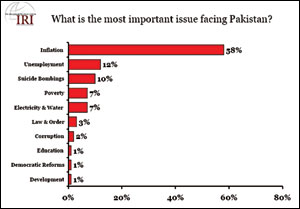 WASHINGTON, Dec 19: As many as 58 per cent Pakistanis say rapidly rising inflation is their main concern.
An opinion survey by the US-based International Republican Institute, released on Friday, shows that a rapidly deteriorating economy has replaced the judicial dispute as the main issue in the country. The quest for judicial independence, however, remains the second most important issue.
When asked to choose their most important issue from a list, 58 per cent respondents cited inflation, 12 per cent unemployment and seven per cent poverty. This represents a total of 77 per cent of the population citing an economic concern as their top priority.
When asked if they thought that the shortages of petrol, natural gas, wheat and electricity were serious problems, 77 per cent replied yes.
When asked to define the issue that was most important to them, 10 per cent said suicide bombings, up from two per cent in June.
While a majority of respondents still said they supported a peace deal with the extremists, their number dropped 10 points to 54 per cent, while the number opposing it rose 17 points to 35 per cent.
Attitudes towards religious extremism were unchanged from the last poll, with 60 per cent saying that it was a serious problem.
The poll saw a six point increase in the number of people who saw the Taliban and Al Qaeda operating in Pakistan as a serious problem, with 51 per cent saying that they were, up from 45 per cent in June.
There was a corresponding increase in the number who said they supported the Pakistan Army fighting the extremists in the NWFP and Fata, with 38 per cent saying yes and 50 per cent saying no -- an increase in support of 11 points over the June poll.
When asked if they agreed that the army needed to fight foreign extremists because they were planning suicide attacks that would kill Pakistanis, 63 per cent said they agreed and 25 per cent said they did not.
The poll also witnessed an increase in support for cooperation with the US in the ‘war on terror’, with 28 per cent responding yes, up 13 points from the last poll.
A majority were still opposed, however, with 63 per cent opposing such cooperation, although this was down from 71 per cent in June.
Despite this increase, Pakistanis remain solidly opposed to US military incursions in the tribal areas, with only 13 per cent supporting and 73 per cent opposing them.
However, when asked if they would support US missile strikes and small raids as long as the Pakistani government was informed first and the attacks were coordinated with the Pakistani Army, 49 per cent said yes and 35 per cent said no.
When asked what they were more concerned about, 54 per cent said US military strikes on terror camps in Pakistan as opposed to 23 per cent citing terrorists using Pakistan as a base of operations to attack Afghanistan.
While the figures are trending towards supporting the war on terror issues and an easy explanation would cite the Marriott hotel bombing in Islamabad as the cause, the numbers tell a different story. When asked who they felt was responsible for the bombing, 50 per cent said that they did not know, 20 per cent named America, 13 per cent said the Pakistani government, five per cent cited the Taliban and two per cent said terrorists. About the military action in the NWFP and Fata, seven per cent said the bombing made them more likely to support such action, 24 per cent said less likely and 42 per cent said it had not changed their opinion.
About 66 per cent of the respondents in the survey agreed that the terrorists were not true Muslims.
Sixty-two per cent said they would like more role of Shariat in the law, while 14 per cent said less.
When asked if President Asif Zardari should retain powers under amendments made to the Constitution by Gen (retd) Musharraf, 48 per cent said they should revert to parliament and 38 per cent said he should retain them.
According to the survey, the army’s image is rebounding after the resignation of Mr Musharraf.