0
0

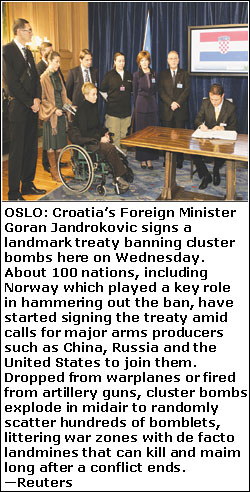 OSLO, Dec 3: Nearly 100 nations began signing a treaty on Wednesday to ban cluster bombs responsible for killing and maiming thousands, but powerful arms producers including the United States, Russia and China remain outside the pact.
Despite that, 18 of the 26 Nato members — including Britain, France and Germany — are expected to ink the pact.
“Today we confirm that cluster munitions are banned forever,” said Norwegian Prime Minister Jens Stoltenberg, the first to sign in a process that would extend over two days. “This convention will make the world a safer and better place to live.”
It was unclear how many of the 125 states that registered for the conference would take part in the signing ceremony at the Oslo city hall, site of the annual Nobel Peace Prize award ceremony.
“If we say there will be plus or minus 100 (signatories), that will be a good start,” Norwegian Foreign Minister Jonas Gahr Stoere told a news conference. “We hope to see more signing in the weeks and months and years ahead.”
Cluster bombs contain scores or even hundreds of sub-munitions — or “bomblets” — that blanket wide areas. Campaigners say this makes them indiscriminate killers.
Since not all the bomblets explode upon impact, duds on the ground can pose lethal dangers to civilians, particularly children, for decades after they are used in combat.
The Convention on Cluster Munitions, adopted by 107 states in Dublin in May, bans the use, production, stockpiling and trade of such weapons.
The treaty requires nations to destroy stockpiles within eight years and to clear contaminated areas within 10 years of the date it comes into force, which will be six months after 30 states ratify the pact.
Signing states must also provide assistance to cluster bomb victims, their families and affected communities.
Norway, Ireland, the Holy See and Sierra Leone will deposit their ratifications immediately upon signing, an official said.
Handicap International, an advocacy group for the maimed and disabled that helps clear deadly ordnance, estimates some 100,000 have been killed or injured by cluster munitions over the decades, based on surveys of affected countries.
“This treaty is a restoration of the spirit and the letter of humanitarian rights,” Jean-Baptiste Richardier, co-founder and director-general of Handicap International, told Reuters.
Laos, which was heavily bombed with cluster bombs during the Vietnam War, causing what Handicap International says were 15,000 deaths and injuries, signed just after host Norway.
Laotian Deputy Prime Minister and Minister of Foreign Affairs Thongloun Sisoulith told the conference the treaty “deserves full global support”.
Following the Oslo ceremony, the treaty will go to the United Nations in New York where more states may sign.—Reuters