0
0

KARACHI, Nov 19: Political infiltration in the trade union movement has divided workers and weakened their struggle for rights.
This was the concerted view of labour leaders and activists who spoke on Wednesday at the inaugural session of the three-day regional consultation on “Workers as citizens: markets and rights in South Asia” organised jointly by the Pakistan Institute of Labour Education and Research and the South Asia Alliance for Poverty Eradication (SAAPE) at the PILER Centre.
Delegates from Bangladesh, Nepal and Sri Lanka are participating in the programme while Indian delegates, who could not get visas on time, are expected to join in on Thursday.
A Sri Lankan delegate, M. R. Shah of the Ceylon Bank Employees Union, observed that by setting up their own labour wings, political parties divided workers’ strength and used the labour wings for their political agenda. He said that most of the time, workers had to struggle against the government for their rights or seek a favourable legislation but the workers group supporting the ruling party would not usually participate fully in the struggle, thus weakening the collective strength of workers.
He said that workers individually might like a political party but they should keep their trade union away from politics and focus only on the issues concerning workers.
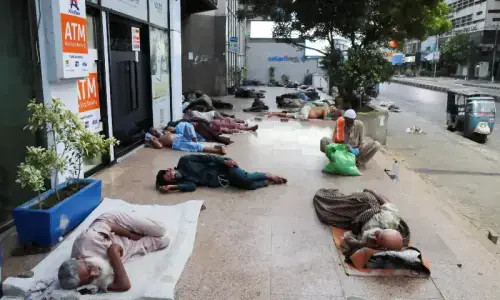
Karamat Ali of PILER said that an overwhelming majority of the South Asian workers — almost 90 per cent in certain countries — were employed in the informal sector which did not give them any rights or benefits. He demanded that the workers of the informal sector be provided with full benefits and brought under the social security net.
He pointed out that almost the entire budget was spent on the debt servicing, military expenditure and governance while very little was left for the social sector like health, education, etc. He was of the view that improved relations between neighbouring countries could stop heavy military spending. He observed that almost 20 per cent of the world population lived in South Asia but about 60 per cent of the world’s poor lived in this region.
General secretary of the Bangladesh Trade Union Kendra Dr Wajeed-ul-Islam said that low wages was a common phenomenon in both the public and private sectors, but public sector workers had comparatively good conditions, while low wages, poor working conditions and poor implementation of labour laws still existed in the private sector. The situation in the informal sector was even more serious, he added.
The Nepalese delegate, Dr Sarba Raj Khadke of SAAPE, said that his country signed the ILO conventions and other international agreements quickly but did not take any concrete steps to seriously and effectively implement them. He said that the masses struggling together had succeeded in getting rid of the monarchy and now the challenge facing the political forces was how to provide rights to everybody judiciously and quickly.
Dr Shahida Wazarat of the Karachi University, Jan Nisar Khalil from the NWFP, Aqeela Naz of the Anjuman Mazareen Punjab, A. Muthulingam from Sri Lanka, Hari Datta Joshi from Nepal and Zeenat Hisam of PILAR also spoke.