0
0

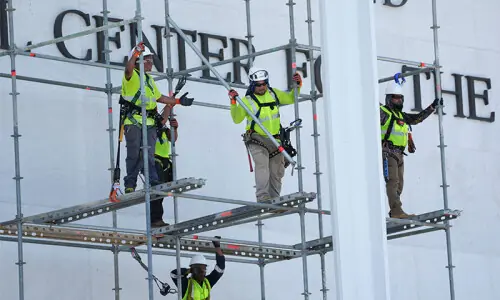
SAMARRA: A ring of scaffolding around charred bricks is all that now stands in place of the golden dome that adorned one of Shias’ holiest shrines.
Militants bombed the Askareeain shrine in the Iraqi city of Samarra in February 2006, destroying the dome and setting off a wave of sectarian bloodshed that killed tens of thousands of people and nearly tipped the country into all-out civil war.
Now, with violence sharply down and Iraq’s coffers swollen with oil revenues, officials hope the mosque can be restored to its former majestic glory in a few years.
That could help heal bitter divisions between majority Shias and minority Sunnis, they say.
“It’s so important for Iraq,” Samarra Mayor Mahmoud Khalaf, who is closely involved in the project, told Reuters. “But it’s also a lot of work. We are working 24/7 to get it finished.”
The al-Askari Mosque, also called the Golden Mosque, was built in 944 and is one of Iraq’s four holiest shrines for Shias.
The dome of the sanctuary was completed in 1905 and had been covered by 72,000 golden pieces.
Two of the 12 revered Shia imams are buried in the shrine – Imam Ali al-Hadi, the 10th Imam, who died in 868, and his son, the 11th Imam Hasan al-Askari, who died in 874.
Getting the shrine back to how it was is a huge task – officials say Iraq expects to spend around $60 million for the project in this mainly Sunni city.
A big part of the challenge is that there are no original drawings to work from, said an architect on the site, who declined to be identified for security reasons.
“We’re working from old photographs, but there’s a lot of guesswork. We’re effectively building the design from scratch,” the architect said. “But we have to get it right: for the shrine and for the imam – and for Iraq.”
No-one claimed responsibility for the bombing of the mosque, although the government blamed Al Qaeda.
Al Qaeda had long been accused of trying to spark a sectarian war in Iraq. This time it worked. In Baghdad, residents were forced out of neighbourhoods if they were of the other sect. In June 2007, suspected Al Qaeda militants also blew up the mosque’s two minarets, which had survived the 2006 bombing.
Pain of the bombing
Unesco, the UN agency for education, science and culture, is helping restore the shrine. Disagreements between Shia and Sunni officials over how to carry out the work had previously held reconstruction back. But in midday heat during the holy month of Ramazan a week ago, a dozen workers mixed concrete and laid bricks on the roof of the mosque where the dome once stood. Most of Samarra was deserted as people fasted and stayed indoors.
“I’m so happy to work here. It’s a holy place and I want to do a service to Imam al-Askari,” said Hisham Qassim, 26, an electrician, adding he didn’t care about being paid.
“I came here before as a pilgrim and it was like paradise. I felt so much pain when it was bombed.”
Some of Samarra’s Sunni residents feel the Shia-led government held them responsible for the mosque’s destruction and hope a restored shrine will heal the mistrust.
“We always felt the government blamed the Sunnis for the bombing, but it wasn’t us: it was Al Qaeda,” said Wasmi Hamed, who leads a Sunni neighbourhood patrol that has helped drive Al Qaeda militants out of the city.
“I was devastated when it happened. I wanted to find whoever did it and cut his head off. Now we want it to be repaired.”
Sunnis, while they don’t attach the same religious importance to the shrine, are keen to see a centrepiece of their ancient city – once a tourist attraction for thousands of Shia pilgrims – restored.
“We used to get so many visitors from all over Iraq to see the shrine. Samarra was a beautiful, rich city. It can be again,” said Sheikh Khalid Hassan, a Sunni tribal leader.—Reuters