0
0

 LIVESTOCK plays an important role in the national economy. Mainly three types of livestock production practices are prevalent, rural households where animals are closely integrated in the rural subsistence economy, using grown fodder and crop residues for livestock feed; large herds are kept in rangelands and commercial farms.
However, except in peri urban and commercial rural farming, most of the herds are undernourished with low productivity and fertility rates.
The commercial livestock farming is dependent on agro-industrial by-products and purchased fodders. In rural farming, the animals suffer from nutritional deficiency by 30 to 50 per cent. On the other hand, constant increase in human population and change in eating habits have increased the demand of milk and meat, which is not going to be met from subsistence farming, where nutritionally starved animals are maintained.
The steep rise in the price of cottonseed cake, wheat bran and wheat straw has also increased the price of milk significantly in urban dairy farming. It is important to increase the proportion of green fodder in animals’ diet, which is the cheapest source of animal feed. However, it can be seen from the Table No. 1 and 2 that fodder production is also on the decline countrywide, particularly in Sindh:
The shortage of fodder production is the major limiting factor for livestock production. In most areas, there is always a shortage of green fodder from mid-April to June and mid-October to December in Sindh.
In Sindh, only 41 per cent (5.79 Mha) is cultivated. Grazing lands are grossly over stocked. Perennial grasses such as Cenchrus biflorus, Cenchrus ciliaris, and panicum turgidum have disappeared due to over-grazing. Growing high yielding fodder crops is an important way of improving livestock nutrition, thereby increasing their production and getting more profit from the production of livestock.
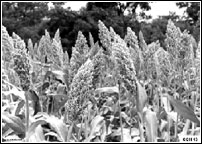
In 2006, fodder crops area amounted to 269,447 ha (4.6 per cent of the cultivated area) and has produced 7,392,576 tones of fodder. Millet (12.8 per cent of the cultivated area) is one of the most important cereals of the desert and mountain areas (Thar, Kachho and Kohistan). It grows in the infertile and semi-arid zones and is mostly confined in rain-fed areas. Sorghum is the main fodder in summer (Kharif) and berseem in winter (Rabi). Berseem, which is a multi-cut annual fodder crop, provides green fodder from December to April in moderate climatic areas. The number of cuttings depends on date of sowing, availability of canal water and fertiliser applications. In optimum condition, 4-5 harvest can be obtained.
At the moment, the fodder situation presents the following characteristics in Sindh: Land, irrigation and quality seed are the major limiting factors to fodder production. Forage yields are very low as compared to their potential. Due to limited land, some farmers prefer to grow cash crops rather than forage and their animals are fed only on dry roughages.
This situation can be changed with intercropping of cash crops-legumes or cereals-legumes to obtain good quality forage for livestock without affecting the main crop. In addition, growing leguminous fodder crops improve soil fertility and its physical properties; also help in increasing the yield of cereal crops when sown in rotation. Rotation of fodder crops with other cereal crops and cash crops also prevent the build up of insect pest and disease incidences, which could occur if same crop is grown year after year on the same piece of land
Given the fodder yield results obtained by the Agriculture Research of Tando Jam under controlled environment (Table 5) shows the potential of our fodder species and compared with production at farm level.
The new strategy can be developed for fodder production in different soil types and agro-ecological zones:
In dry and light saline soils, multi-cut hybrid jowar (sorghum) is the most valuable productive crop. In areas where the weather is unpredictable and in early kharif land with salinity and drought problem, same time in late kharif, high rainfall creates the drainage problem; in such conditions Janter (Sesbania aculeate) is the most suitable crop though its yield remains low.
In irrigated well-drained soils maize and mott fodders are the best crops. In Rabi season, berseem is a suitable crop for most of lands provided water is available for frequent watering at initial stage. Oats and barley can be used as fodder crop in Rabi season where water availability is low. Burro (desert specie of sorghum) fodder is beneficial for very arid areas; however it does not succeed in soils where water table is high and during rain fall when water drainage is not available.
On saline and water-logged soils only two fodder plant species Australian Babar (Acacia ampliceps) & Kalar Mar Gah (Leptochola fusca) have been found successful and they shall be propagated for fodder production and soil improvement.
Fodder trees, such as Acacia, Ipil Ipil (Leucaena leucocephala) and Australian Babar (Acacia ampliceps) are suitable for providing the green foliage during fodder shortage gaps and they are also alternate source of protein.
There is also a need of establishment of fodder research and production institute, where agronomist, plant breeders and animal scientists could work jointly---in the same pattern as Sarghodha Fodder Research Institute has been established in Punjab province.