0
0

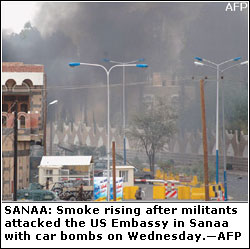 SANAA, Sept 17: Two suicide car bombs set off a series of explosions outside the heavily fortified US embassy in Yemen on Wednesday, killing 16 people including six attackers, a Yemeni interior ministry official said.
The US State Department said the bombings bore “all the hallmarks” of an Al Qaeda attack but the United States had not yet concluded who was to blame.
Islamic Jihad in Yemen, which is unrelated to the Palestinian group with a similar name, claimed responsibility and threatened attacks on other embassies including those of Britain, Saudi Arabia, and the United Arab Emirates.
It had threatened in a statement on Tuesday to launch a series of attacks unless the Yemeni government met its demands for the release of several members from jail.
“We, the organisation of Islamic Jihad in Yemen, declare our responsibility for the suicide attack on the American embassy in Sanaa,” the group said in a statement on Wednesday.“We will carry out the rest of the series of attacks on the other embassies that were declared previously, until our demands are met by the Yemeni government.”
When asked which group was suspected in the attack, State Department spokesman Sean McCormack said: “After talking to the security personnel, the attack bears all the hallmarks of an Al Qaeda attack where you have multiple vehicle-borne devices.”
Yemen has grappled with a spate of Al Qaeda attacks this year, including one on the US embassy, another near the Italian mission and others on Western tourists.
A Yemeni interior ministry official said the suicide attackers had tried to break through the heavily guarded gates of the embassy with their cars but had failed, and that the building was not seriously damaged.
Among the dead were six attackers and four bystanders. The rest were Yemeni security personnel, including one embassy guard. All the dead were Yemeni, with the exception of one Indian woman who was walking past when the attack happened, the official added.
Islamic Jihad in Yemen has been involved in previous attacks on Western targets in Yemen including a US hospital. The leader of the group was executed in 1999 for the kidnapping of 16 Western tourists, four of whom died in a botched army attack to free them.
An Al Qaeda-affiliated group claimed responsibility in March for a mortar attack that missed the US embassy but wounded 13 girls at a nearby school.
The United States ordered non-essential staff to leave Yemen in April, a day after an attack on a residential compound.—Reuters