0
0

COLOMBO, July 29: The leaders of India and Pakistan are to meet in Sri Lanka early next month for their highest-level talks in 15 months and to see if they can keep their peace process intact.
Relations between New Delhi and Islamabad hit a low point this month after India claimed “elements” in Pakistan were behind the recent bombing of its Kabul embassy. There has also been an increase in incidents along the Line of Control.
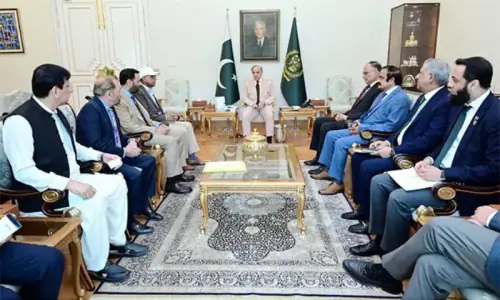
Amid the growing tensions between the nuclear-armed countries, Indian Foreign Minister Pranab Mukherjee is expected to meet his Pakistani counterpart Shah Mahmood Qureshi on the sidelines of a South Asia regional meeting in Sri Lanka.
Indian Prime Minister Manmohan Singh will also be meeting his Pakistani counterpart Yousuf Raza Gilani at the eight-member South Asian Association for Regional Cooperation (Saarc) summit which begins on Saturday.
“The meeting (between Singh and Gilani) is being scheduled,” a Sri Lankan official involved with the arrangements told AFP.
“I think the effort of both sides will be to see that even if there is no breakthrough, there is no break-off,” said analyst C. Uday Bhaskar, former head of the Institute of Defence Studies and Analyses think-tank in New Delhi.
Retired Indian diplomat Kanwal Sibal also said that “both countries will aim to keep the dialogue process alive”. “The level of trust that had been slowly built up over the past four years has been affected,” Sibal said.
“This in turn will affect the content of the dialogue process.”Last week Indian Foreign Secretary Shiv Shankar Menon said the peace process, launched in 2004, was “under stress,” but said talks should continue.
Two years ago, New Delhi stalled the dialogue process in the aftermath of a series of bomb blasts on commuter trains in India’s commercial capital Mumbai in which 186 people were killed --- an attack blamed on Islamabad.
It was resumed only after Premier Singh and Pakistani President Pervez Musharraf agreed to constitute an anti-terror panel to share intelligence on such attacks.
Indian security analyst Bharat Karnad, with the New Delhi-based Centre for Policy Research, said the future of the India-Pakistan peace talks depended on the “political will” of the two governments.
“I think the two governments will be under pressure to ensure the talks do not break down as the common people on both sides will not accept the floundering of relations after the recent rapprochement,” he said.—AFP