



 0
0

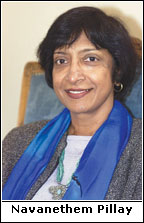 UNITED NATIONS: United Nations chief Ban Ki-moon has appointed South African judge Navanethem Pillay to succeed Louise Arbour as his high commissioner for human rights.
Ms Pillay, who has been with the ICC since 2003, was picked from a short list that also included prominent Pakistani lawyer and human rights activist Hina Jilani and Argentine human rights lawyer Juan Mendez, according to diplomats and UN officials.
Navanethem Pillay, the daughter of a bus driver, became the first non-white woman judge to sit in South Africa’s highest court.
Born in Durban in 1941 of Tamil descent, Pillay has built up a formidable reputation during a legal career that stretches back over four decades, initially coming to prominence back in 1967 when she became the first woman to set up practice in the eastern Natal (now KwaZulu Natal) province.
She subsequently carved out a reputation as a doughty defender of opponents of the whites-only apartheid regime and a proponent of women’s rights.
In 1973, she brought a successful application against the authorities running the notorious Robben Island penal colony which enabled political prisoners -- including Nelson Mandela -- to have access to lawyers.
In 1995, only a year after the collapse of apartheid, Pillay made legal history by becoming the first woman of colour to be appointed to the supreme court in South Africa.
She first came to wider international attention as part of the panel of judges serving on the International Criminal Tribunal for Rwanda.
Under Pillay’s presidency, the court handed down a landmark ruling in 1998 in which rape was held to be a crime against humanity.
She has been serving as a member of the International Criminal Court (ICC), based in The Hague, since 2003.
Pillay once admitted in an exchange with a South African judicial service commission publication that she had struggled to be taken seriously in her early years, especially as a woman, but would eventually win over the doubters.
“I remember that when I was handling my first big ANC security trial they referred to me as girl, the Zulu word “intombi”, and as the trial progressed I found that they had switched to woman,” she said.
“But clients I think respect you for, you know, judge you by your performance, whether you are male or female and that is how it has been with me.”—AFP


























