0
0

AOMORI (Japan), June 7: The United States and Asia’s four largest powers voiced “serious concerns” on Saturday after the single biggest one-day hike in oil prices, warning that the global economy was at risk.
The five nations nonetheless voiced support for gradually scaling back fuel subsidies and letting the market dictate prices, although India and China said they planned to take no action soon on the politically sensitive issue.
Oil prices, which have soared five-fold since 2003, posted their highest ever one-day gain of $10.75 to close at a new record of $138.54 in New York after hawkish remarks by an Israeli official on oil producer Iran.
Senior officials from the United States, Japan, China, India and South Korea said in a joint statement after talks in Aomori, Japan that they “share serious concerns” about the current level of oil prices.
“These prices are unprecedented and against the interest of both consuming and producing countries. They pose a great burden — particularly on resource-scarce developing countries,” it said.
They called on oil producing countries to “increase investment to keep markets well supplied in response to rising world demand.” Japan’s energy minister Akira Amari, who chaired the meeting, said that rising oil prices were “a major risk factor” for the world economy.
“We want to issue a message on this to the world,” Amari said.
South Korea’s Knowledge Economy Minister Lee Youn-Ho told Amari earlier in the day: “It is fairly questionable whether the world economy will be able to develop further at this level of crude oil prices.” But US Energy Secretary Samuel Bodman cautioned it would take time to solve all of the concerns over the oil industry.
“It’s important for citizens of the world to know that this has been a long time coming and it’s not going to be something we are going to walk our way out of in a matter of a month or even a year or two,” Bodman said.
The talks will be followed Sunday by a meeting of the energy ministers of the Group of Eight industrial powers here in Aomori, a hub of Japan’s nuclear energy industry 600 kilometres north of Tokyo.
Despite the political sensitivity, today ’s joint statement supported a scaling down of fuel subsidies, saying it would “enhance energy efficiency” and lead to investment in alternative energy.
Developing economies tend to heavily subsidise fuel costs in a bid to ease the burden on the poorest members of society.
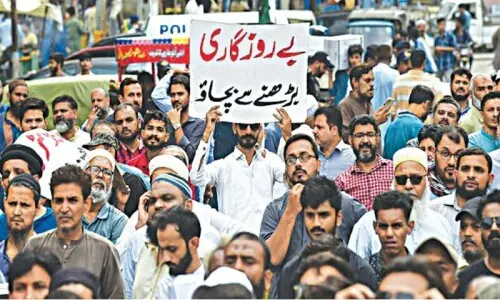
India and Indonesia have recently been forced to hike prices amid soaring global crude oil costs, triggering large anti-government demonstrations in the two countries.
India’s oil minister, Murli Deora, cancelled his attendance at the talks in Japan at the last minute due to the political situation at home.
He was replaced by India’s ambassador to Japan, Hemant Krishan Singh, who said it was not “accurate or correct” to describe the statement as an agreement to remove subsidies now.
“We are still not in the position to move to the fully market determined pricing. In the long-term, I would say each country would have to devise its own plans with regard of levels of subsidies,” he said.
Zhang Guobao, vice chairman of China’s National Development and Reform Commission, also did not indicate any timeframe for lowering subsidies.
“China is still a developing country and has weak industries, such as agriculture, and public transport, such as taxis,” Zhang told reporters.
“We have to move giving careful consideration to social and political stability,” he said.
The joint statement said the five nations recognised that “phased and gradual withdrawal of price subsidies for conventional energies is desirable.” They said that subsidies “should be replaced wherever possible by better targeted policies for intended beneficiaries.” Soaring oil prices have been blamed on a variety of factors including turbulence in the Middle East and rising consumption by emerging economies such as China and India.
Analysts said the sharp spike overnight was a reaction after Israeli Deputy Prime Minister Shaul Mofaz reportedly warned of an attack on Iran if the major oil producer continued its alleged nuclear weapons drive.—AFP