0
0

PESHAWAR, June 4: The Citizens Foundation (TCF) on Wednesday launched its Peshawar chapter to impart standard education to children of the under-privileged and downtrodden segment of the society.
The foundation seeks to generate funds to establish schools in the Frontier province.
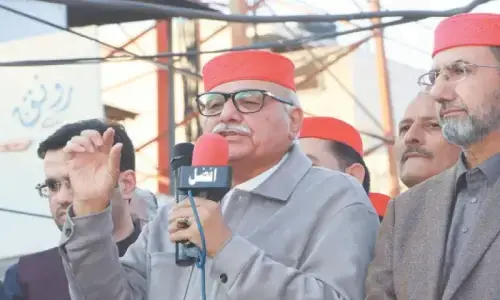
Former caretaker chief minister Shamsul Mulk was the chief guest at the launching ceremony.
Lubna Farooq, an entrepreneur who brought the TCF to the NWFP to help set up schools in less-developed areas, has been named as the NWFP coordinator of a TCF support group comprising Amir Farooq, Mrs Roidar Kabir, Khalid Sultan Khwaja, Ghulam Norani Sethi and Fazl Ilahi.
The TCF is a non-profit organisation set up in 1995 by a group of people, which turned into one of Pakistan’s leading organisations in the field of formal education.
It has established 455 schools nationwide with an enrolment of 55,000 students. Over 4,500 jobs have been created in the communities where the TCF operates.
Ms Lubna regretted that the previous Muttahida Majlis-i-Amal government had made pledges to introduce the school system in the province, but had taken no practical steps.She praised former caretaker CM Shamsul Mulk for ordering provision of government land to TCF schools in almost all districts of the province.
Mr Mulk highlighted importance of education and said much work was needed to be done in the field of education in the province and adjacent tribal areas.
He also announced to provide land in the GIK institute in Topi to the TCF for opening a college and a vocational centre.
Azam Khan, who donated eight kanals of land for a TCF-run school in Shahai, Peshawar, said the NWFP caretaker government had identified about 40 sites across the province where the TCF could establish schools on government land.
One TCF school is already operating in Shaidu in the Nowshera district where the land was provided by the Ghulam Farooq group of Industries.
Ms Lubna said a student in the TCF schools had to pay a token fee of Rs10 to Rs150 at the primary level and up to Rs250 monthly at the secondary level.
She hoped that the provincial government and well-off people would extend their cooperation to establish a network of schools for the poor where they could get standard and qualitative education for minimum fees.—Bureau Report