



 0
0

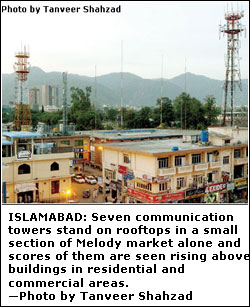 ISLAMABAD, May 2: City fathers have woke to the dangers the mushrooming cellphone towers on rooftops pose and decided to remove those installed “illegally” or “without prior approval”.
An official of the Capital Development Authority (CDA) said a new policy on setting up Base Transceiver Stations (BTS) in the federal capital was chalked out at a special meeting presided over by CDA Chairman Kamran Lashari.
“Under it mobile telephone companies would be discouraged to install BTS in residential areas. Those who do so illegally would face heavy fine,” he said.
But spokesmen for several mobile phone companies claimed that not one BTS had been installed without the CDA approval.
They said CDA charged a heavy fee for giving its approval. ”Fixing a BTS tower is not a one-day job. It takes few days. If any was installed illegally why not CDA act in time to stop its erection?” one spokesman said.
CDA considers over 100 BTS towers in the city to be illegal.
Though according to the CDA official, rules prohibit putting BTS towers on residential and commercial buildings. But a large number of them are seen sprouting from rooftops in residential areas and markets.
“We have decided to fine the cell phone companies violating CDA laws five times the fee the CDA charges for approving a site for fixing BTS tower,” the official said.
Last year, the former government had determined that more than 300 of the 10,000 telecom towers in the country were a risk to public health and decided that they should be redesigned and relocated.
However the CDA official ruled out the possibility of the BTS having any impact on human health.
“Only if one comes within 8 metres and directly in front of an antenna’s radiating surface, not the tower itself, can there be a possibility of exposure to radiation levels dangerous to human health,” the official said.
“And antennas are mounted 20 to 35 metres high to minimise the risks. In fact the power density of electromagnetic radiation from antennas is 100 times less than the level that would be a danger to human health,” he added.
Former IT Minister Awais Leghari had said his ministry conducted a study to analyse radiation hazards the BTS posed as defined by the International Council for Non-Ionising Radiation Protection and had circulated its findings to other ministries, PTA and the industry for comments.
The study had concluded that the bulk of medical research on the health related effects of electromagnetic radiation emitted from antennas on telecom towers produced no conclusive evidence of hazards to human health.
The demand for wireless telephony in the country in general and cellular in particular is projected to grow in the coming years and so the BTS too.
Due to heavy investment by operators, the total number of cellular mobile and Wireless Local Loop (WLL) base stations in the country reached to 13,000 during 2007.




























