0
0

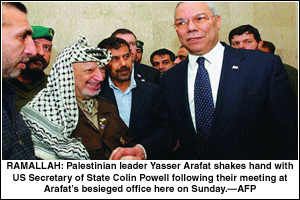 TEL AVIV, April 14: Israeli Prime Minister Ariel Sharon did not give any timetable for pulling back his troops from the West Bank during new talks on Sunday with US Secretary of State Colin Powell, an Israeli official said.
Powell met with Sharon for about an hour after conferring earlier on Sunday with Palestinian leader Yasser Arafat in his besieged West Bank headquarters in the town of Ramallah.
“He (Sharon) repeated that once the operation was done, troops would withdraw,” said the official. He added that the Israeli leader did not give a timetable.
POWELL-ARAFAT MEETING: US Secretary of State Colin Powell pressed for an end to suicide attacks on Israel in talks with Yasser Arafat in Ramallah on Sunday, but was told a ceasefire hangs on Israel’s pullout from the West Bank.
Powell stepped up the pressure on Arafat in the latest round of his Middle East mission, aimed at nailing down an elusive ceasefire that could bring an end to 18 months of bloodshed.
Palestinian officials insisted their side was ready for peace but that Israeli Prime Minister Ariel Sharon must end his army’s 17-day assault on the West Bank, which Sharon says will not happen until “the terrorist infrastructure” is crushed.
“We just completed a useful and constructive exchange with Chairman Arafat and his staff,” Powell said after a three-hour meeting at Arafat’s besieged West Bank headquarters, ringed by Israeli troops.
“We exchanged a variety of ideas and discussed steps how we can move forward,” he said. Arafat, pinned down in his compound by Israeli forces since the siege began, did not come out to speak to reporters.
A senior US official said Powell repeatedly insisted that “the bombings had to end,”.
Arafat aide Nabil Abu Rudeina said, we want more efforts and pressure from the Americans to get out of this crisis, and end the war and aggression declared by the Israeli government on the Palestinian people.
SUPREME COURT VERDICT: The Israeli supreme court ruled that Israeli troops could begin burying bodies in the camp, which is one of the three West Bank areas after they are identified by their families in coordination with the ICRC.
The camp saw the most brutal fighting between Israelis and Palestinians since the Palestinian uprising in September 2000.
CEASEFIRE: US and Palestinian officials will meet today (Monday) to work on arranging a Middle East ceasefire in a follow-up to Secretary of State Colin Powell’s meeting with Palestinian President Yasser Arafat, the United States said in Washington on Sunday.
“The first thing we will have to have is a ceasefire and that’s what the secretary’s staff is looking to try to work out tomorrow,” deputy Secretary of State Richard Armitage said on the CBS “Face the Nation” programme.
The White House on Sunday welcomed Powell’s meeting with Arafat as useful and said it hoped it would be a step toward a Middle East peace deal.
The White House also said it hoped Egypt, Jordan and Saudi Arabia would help to work for a permanent peace settlement, but a key Democrat said it is up to the United States to take the lead toward a deal.
BEIRUT: Colin Powell will visit Lebanon and Syria, government sources said on Sunday, after cross-border attacks by Syrian-backed Hezbollah guerrillas on Israeli targets fanned fears of regional conflict.
Government sources said Powell would meet with Lebanese President Emile Lahoud and Prime Minister Rafik al-Hariri on Monday, after days of talks with Palestinian and Israeli officials aimed at ending Israel’s offensive in Palestinian areas of the West Bank.
JENIN REFUGEE CAMP: Israeli soldiers on Sunday hunted for booby traps amid decaying Palestinian bodies in the rubble of Jenin refugee camp, scene of the fiercest fighting in Israel’s West Bank offensive.
The fly-infested corpse of a Palestinian militant in fatigues sat upright in the camp’s demolished main square, bulldozed by the army.
Reporters were escorted into the camp by the army for the first time, three days after the last serious resistance abated and a day after a Reuters news team eluded patrolling tanks and found bodies rotting in homes occupied by women and children.—Agencies