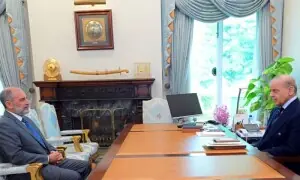
ISLAMABAD, Jan 11: Prime Minister Mohammedmian Soomro has sought the nation’s support in energy conservation efforts to confront the challenge of energy shortage.
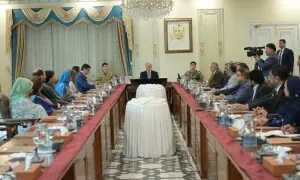
“It is the need of the hour as we have to share the national resources justly and keep up the pace of economic progress,” he said. The prime minister was chairing a special meeting on Friday to review the energy situation.
He said the government needed the support of “every family, every institution and every sector” to reduce the consumption of electricity, gas and oil.
He said factory owners, agriculturalists, businessmen, workers and the common man would have to make “some sacrifice” and determine for themselves how to cut their energy consumption.
The meeting decided to revive the Energy Conservation Council for taking decisions regarding energy conservation. The prime minister said that he would monitor the implementation of the energy conservation programme.
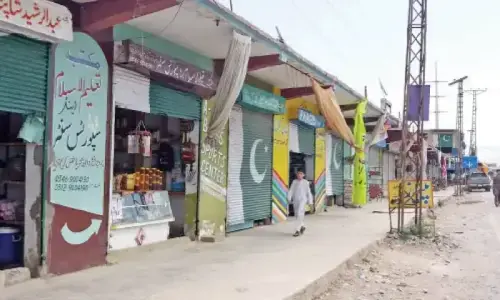
The meeting agreed upon some immediate measures as well as some long-term decisions to help overcome the situation. It was decided that shopping centres throughout the country would close down by 7.30 in the evening and the electricity and gas thus saved could be utilised both by the domestic consumers and the industrial sector.
The loadshedding would be managed in such a manner that domestic consumers could contribute their share during daylight and the electricity thus saved could be diverted to agriculture and industry.
The meeting decided that the provincial and local governments would be asked to approach the managements of schools, particularly private institutions, to encourage students to use school buses.
Those schools, which do not have buses, would be advised to acquire the services of private transporters or buy vehicles for the purpose of pick and drop. The school management and teachers would be asked to persuade students into going to bed early.
Industrialists would be asked to switch over to such operations as would result in saving energy.
The meeting decided to ban the use of gas-run geysers in the “near future” and to replace them with appliances using solar energy.
Some experts pointed out that solar geysers cost thrice as much as gas geysers, but others said the heating would be virtually free once the cost was offset in 30 months.
The meeting decided that the energy policy, approved by the cabinet in Nov 2006, should be immediately implemented to effect savings by both residential and commercial consumers.
The participants were confident that if consumers followed the government’s recommendations, consumption would come down by at least 25 per cent.
This would translate, in dollars, to two billion, according to experts.—APP