0
0

PESHAWAR, Oct 22: A leading member of Hekmatyar’s ousted government on Sunday said that the days of bloody power struggles that allowed Afghanistan’s Taliban to sweep into Kabul five years ago as bringers of peace were a thing of the past.
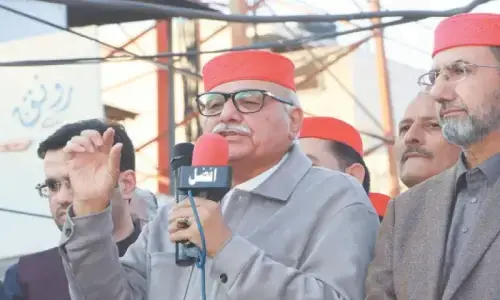
Qazi Amin Wiqad, Pakistan representative of the radical Hezb-i-Islami party that destroyed large swathes of Kabul in the 1990s, assured Afghan tribal leaders on Sunday that the interests of their nation exceeded those of political parties.
“We will not kill our brothers anymore,” Wiqad declared in a veiled reference to the brutal internecine battles for Kabul that followed the fall of the Soviet-installed government in 1992.
The party’s leader, Gulbuddin Hekmatyar, now living in Iran, bombarded Kabul with hundreds of rockets from his base on the outskirts for a year in 1992 and 1993, destroying large parts of the city and killing thousands before he became prime minister in the government of President Barhanuddin Rabbani.
He later resumed devastating rockets attacks on the capital which only ended when the Taliban, a fundamentalist movement that arose in reaction to the chaos caused by the civil war among the Mujahideen, seized his rocket bases south of Kabul in February 1995.
The brutal fighting between Hekmatyar and the late Ahmad Shah Masood, the legendary commander who founded the Northern Alliance now fighting the Taliban in northern Afghanistan, discredited the Mujahideen parties and soured public opinion against the men whose valiant war of resistance drove out the Soviet army.
Wiqad said Hezb-i-Islami fighters in Afghanistan were now scattered, some siding with the ruling Taliban, some supporting the opposition now trying to unseat the fundamentalists and some not active at all.
DEEP SPLIT: Waqid even praised the Northern Alliance for agreeing with supporters of ex-King Zahir Shah to work together to convene a Loya Jirga and choose a broad-based government to replace the Taliban.
He made clear his support was not for Zahir Shah personally but for the unity movement he was leading.
But he indicated that Hezb-i-Islami was now deeply split as its leaders differed over whether to support Zahir Shah.
Hekmatyar, the Mujahideen leader with the strongest support from Pakistan’s powerful Inter Services Intelligence (ISI) during the war against the Soviet Union, has kept up a barrage of anti-king and pro-Taliban statements in interviews from his exiled headquarters in Tehran.
But Wiqad, dismissed his statements and said Hezb-i-Islami supporters based in Pakistan supported the king’s plan for the grand assembly as the best chance for national unity and peace in Afghanistan.
Asked about Hekmatyar’s calls for Afghans to fight with the Taliban against the United States, Wiqad told Reuters: “That was an emotional response from Gulbuddin Hekmatyar. In Pakistan, Hezb-i-Islami supporters are with us working for national unity.”
In a recent interview, Hekmatyar told the daily The Nation his men would fight with the Taliban against the United States, which he said wanted to make Zahir Shah an American puppet.
This public rift in the once iron-disciplined Hezb-i-Islami, which often fought more against rival Mujahideen groups than against Soviet forces, raised hopes the party would not play the spoiler role it did from 1992 to 1996, when it waged a civil war against fellow Mujahideen governing in Kabul.—Reuters