0
0

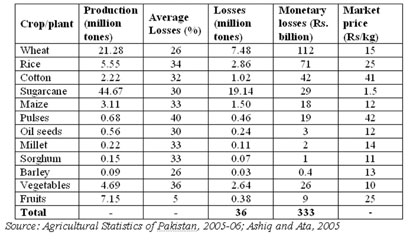 WEEDS are the most common pests of crop plants which reduce the yield by 36 million tons inflicting losses worth Rs333 billion per annum to the economy.
They are the hidden enemies which damage field crops, vegetables and fruit plants without making farmers notice the losses. That is why most farmers ignore them unlike insect-pests and diseases.
Weeds compete with main crop plants for nutrients, moisture, space and solar radiation. They act as alternate host for several insect-pests and diseases, weaken the crop plant and spoil quality of the produce. Many weeds are parasites too. They also impede cultural operations and hinder cultivation, hoeing, spraying, irrigation and harvesting of crops.
They clog irrigation channels reducing efficiency of irrigation systems. Some weeds also release toxic chemicals (allelo chemicals) which hamper growth and development of crop plants. Table:
The losses caused by weeds vary in different crops, fruits and vegetables depending on the type and extent of weeds; its growth habit and life span; type of crop and control measures; soil and climatic conditions; and duration of the weed-crop competition.
Wheat crop ranks first with suffering losses of 7.48m tons worth Rs112 billion. If the losses are minimisd by 50 per cent, the yield will increase by three to four million tons.
The losses incurred by rice due to weeds are estimated at 2.86m tons worth Rs71 billion. Weeds reduce cotton production by one million tons worth Rs42 billion; sugarcane suffers reduction by 19.14m tons worth Rs29 billion.
Maize is the third important cereal after wheat and rice. Its production is reduced by 1.4m tons causing a loss of Rs18 billion.
Production of four important pulse crops (gram, lentil, moong and mash) is reduced by 0.46m tons worth Rs19 billion. Oilseed crops (rape seed/mustard, canola, soybean, and sunflower) suffer Rs3 billion losses.
Millet, sorghum and barley are also affected by weeds resulting in Rs2 billion, one billion and 0.4 billion losses respectively. Vegetables suffer production loss of 2.64m tons estimated at Rs26 billion. Although, the losses caused by weeds in fruit plants are only five per cent, these cause Rs9 billion losses each year.
If we minimise the weeds to economic threshold level, it will boost production of crops, fruits and vegetables. Consequently, the economy would be improved.
Eradication of weeds is neither possible nor desirable. As their effects are not visible, farmers do not care for their management.
The herbicide use in the country is only 15 per cent of total pesticides while in the world this figure is more than 50 per cent of total pesticides used.
Many farmers lack proper knowledge of herbicide selection and application. They purchase herbicides with out considering weed flora of their fields which results in poor control and wastage of money.
A new farmer should first visit crop fields and know previous history of weeds. The herbicides should be purchased keeping in view the type of weeds present.
Application of herbicides is also a crucial problem faced by farming community. Nozzle of the sprayer is an important factor in uniform distribution and efficacy of herbicides.
Usually, hollow cone nozzle is used by majority of farmers for application of insecticides in cotton, sugarcane, maize, fruits and vegetables which is not suitable for spraying herbicides.
Flat-fan or flood-jet nozzles are recommended for efficient application of herbicides. Mostly, farmers do not use the recommended dose of herbicide, which either does not control weeds or cause damage to crops.
Another emerging threat to the crops/economy is the introduction/appearance of certain extremely dangerous and aggressive new weeds like parthenium and Zaleya pentandra which were not previously found here.
The possible reason for the emergence of such weeds is change in weed ecology.
A detailed survey should be conducted to evaluate weed flora of different agro-ecological regions of the country and new weeds should be identified to develop strategies for their successful management.
There is a need to educate and guide farmers about harmful effects of weeds and adverse effects of herbicides on environment including soil and water. Integrated weed management approach is needed for managing weeds.
The agriculture department of each province should focus on removing weeds in their extension and training programmes.
A comprehensive weed-control programme and about their management is need of the hour to limit weed population at economic threshold level and overcome the losses caused by them to the national economy.