0
0

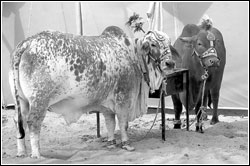 A VERY big livestock market is set up in Karachi every year for about a month during Eid-ul-Azha where over one million animals - about 0.4 million large ruminants and more than 0.6 million small ruminants - are brought from various parts of the country.
Over 60 per cent of these animals belong to Punjab, 40 per cent to rural Sindh and 10 per cent to Balochistan.
These sacrificial animals which are specially fed and reared are mostly beautiful and fat and fetch high prices.
The Karachi cattle market set up on the occasion of Eid is one of the largest livestock market in Asia. As far as large ruminants are concerned about 0.5 per cent of them are crossbreed of Frisian and Cherolias which fetch higher prices than local animals. Some animals are sold for more than a few hundred thousand rupees each.
Local animals reared specially for sacrifice mainly in Punjab and surrounding areas are Cholistani Dajal and Dhani breeds; in Balochistan are Bhaghnari; and in Sindh are Tharparkar and Kankrej breeds.
As these animals come from every part of the country, the owners who are familiar with foot-and-mouth disease and conditions prevalent at the livestock markets get their animals vaccinated.
But new farmers or the farmers coming from far-flung areas, where there is no such facility, or the farmers who are not familiar with the disease and its losses, and the traders who purchase animals one to two months prior to the festival do not vaccinate their animals which are prone to the disease.
After reaching the market these animals may get infected with the disease and spread it to other healthy animals.
Foot-and-mouth is a viral disease which is highly infectious. The main symptoms of the disease is high fever (104oF to 105oF), vesicles on tongue, gums, dental pad, inner side of lips, mammary glands and foot with dribbling of saliva from mouth.
Some times the saliva is blood-stained and the animal is unable to eat and walk.
Especially the foreign crossbreed animals are highly prone to such disease.
The conditions which favour the outbreak of this disease are cold weather mainly the months of November, December, February and March, stress on animals, over crowding of the animals, keeping animals in hard and hilly areas, unsanitary conditions, areas infested with flies and mosquitoes, non-availability and shortage of fresh and clean water, supply of hard and dry fodder or spoiled green fodder containing fungus and keeping the animals standing for a long period in open space without any shelter.
Fodder contaminated with concrete and mud inflicts injuries to the tongue and mouth of the animal while consuming food which usually results in the infection.
In case of outbreak of the disease, heavy losses are suffered by the cattle traders as the sacrificial animals become weak, loose weight and beauty and do not attract buyers.
Many of the animals also die of this disease. The sign of the disease in a bigger market is very clear.
If the crossbreed animals show symptoms of the disease first, it is obvious to be a foot-and-mouth disease, and soon the local animals of the market also get infected with this viral disease which, if not controlled, soon assumes epidemic proportion. The disease is contagious and spreads very rapidly.
Protection against the disease: A comprehensive plan is needed to control the disease.
The area of the market should be separated into blocks and given numbers.
Each block should be allowed to accommodate only 1,000 animals to make it technically easy to look after them.
At the entry points of the cattle market shallow ditches should be made and filled with formalin solution with a concentration of three per cent to four per cent or copper sulphate solution four to five per cent so that animals and workers while entering into the market pass through this solution which kills the pathogenic organism.
The foreign crossbreed animals should be kept away from the local breed; the premises should be kept clean, hygienic and sprayed with disinfectants daily to kill mosquitoes, flies and bugs; clean wooden mangers should be used for feeding the animals and they should be cleaned daily.
Animal waste and other garbage should be removed from the premises.
The animals and traders should be provided with sheds and clean and fresh water.
Fodder should be protected against contamination specially mud and concrete particles.
The market managers and head of the veterinary department should work in close coordination to control any epidemic. For full animal health cover, one veterinary aid centre fully staffed and equipped with a sick ward per 10,000 animals should be established, and one mobile unit working 24 hours should be set up. In case of any disease, the sick animals should be segregated from healthy one and kept in sick ward and treated accordingly until cured.
In case of symptom like foot-and-mouth disease and vesicular stomatitis (same symptoms like foot-and-mouth) the animal in addition to mouth wash with alum solution, should be treated with antibiotic or sulpha drugs.
Protection of animals against such diseases at livestock market is necessary to save both the cattle sellers and buyers from losses and preventing the disease to assume an epidemic proportion.