BEIRUT, Nov 24: Lebanese Prime Minister Fuad Siniora on Saturday stepped into the political vacuum left by parliament’s failure to elect a president, but vowed to help find a head of state as quickly as possible.
President Emile Lahoud left office shortly before midnight on Friday amid a feud over who was in charge in the politically divided nation.
Siniora, whose government effectively took charge of the country on Saturday in line with the constitution, told reporters “we will exert all efforts to carry out as soon as possible the election in line with the constitution.” “We, as a government, will continue to carry out our duties as provided by the constitution,” he said after meeting with Maronite Cardinal Nasrallah Sfeir, from whose community Lebanese presidents are drawn.
The crisis has prompted fears that two rival governments could be formed, as was the case at the end of the 1975-1990 civil war.
Siniora dismissed Lahoud’s parting statement on Friday in which he said he was handing over responsibility for the country’s security to the army on the grounds that conditions existed “which could lead to a state of emergency.” “There is no need for a state of emergency ... the army is carrying out its duties,” Siniora said.
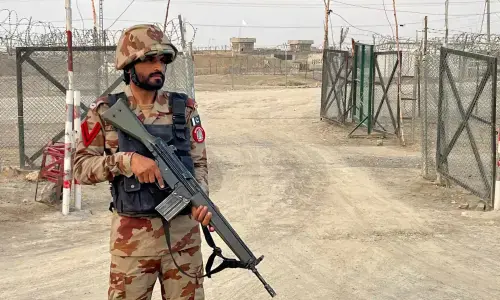
The army, which did not wish to comment on political developments, has been maintaining order on the streets of Lebanese cities since the 2005 murder of former prime minister Rafiq Hariri, which triggered massive protests.
With even more tanks and troops on the streets of Beirut this week to maintain security, the situation was calm Saturday with no reports of unrest or clashes.
The Hezbollah-led opposition has kept silent since Friday, but expressed confidence in the army’s capability to maintain order.
“The situation is tense, but there is full confidence in the Lebanese army and its capability to maintain order in all Lebanese regions,” said MP Ali Khreiss, from the Shiite movement Amal of influential parliament speaker Nabih Berri.
“The political conflict over the presidency will not escalate,” he said, asserting that “the Lebanese are capable of reaching an agreement on the presidency and all other lingering issues.” Newspapers said Lebanon had been plunged into an organized political chaos pending a parliamentary session next Friday to elect Lahoud’s successor.
“Lahoud’s era ends with a republic with no head of state,” the leading An-Nahar daily said, adding that “security and political guarantees rule during the transitional period” until next Friday.
The United States, the European Union and other countries appealed for calm and urged both sides to quickly negotiate an end to the crisis and spare the country further turmoil.
Washington offered its support to Siniora’s government and urged “all Lebanese political groups to do their part to maintain calm and promote security for Lebanon’s citizens.”—AFP