0
0

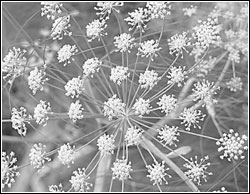 FENNEL (Sounf) belongs to the family Apiaceae. It was cultivated by the ancient Romans for its aromatic fruits and succulent, edible shoots. It is a hardy, perennial, umbelliferous herb, with yellow flowers and feathery leaves with thick, perennial root-stock.
The stems are stout, four to five feet or more in height, erect and cylindrical, bright green and smooth with many branches bearing leaves cut into very finest of segments.
The bright golden flowers produced in large flat terminal umbels with 13 to 20 rays, are in bloom in July and August.
In the kitchen garden, this ornamental plant generally has its stems cut down to secure a constant crop of green leaves for flavouring and garnishing. In the original wild condition, it is variable as to size, habit, shape and colour of leaf, number of rays in the flower-head or umbel, and shape of fruit, but it has been under cultivation for so long that there are now several well-marked species.
The fennel thrives anywhere, and a plantation lasts for years. It is easily propagated by seeds, sown early in April in ordinary soil. It likes plenty of sun and is adapted to dry and sunny situations.
It does not need heavily manured soil, though it will yield more on rich stiff soil. From 4 1/2 to 5 lb of seed are sown per acre, either in drills, 15 inches apart, lightly, just covered with soil and the plants afterwards thinned to a similar distance, or sewn thinly in a bed and transplanted when large enough. The fruit is heavy and a crop of 15 cwt. per acre is an average yield.
The roots of fennel were formerly employed in medicine, but are generally inferior in virtues to the fruit, which is now the only portion recognised.
There are several varieties of fennel fruit known in commerce - sweet or Roman fennel, German or Saxon fennel, wild or bitter fennel, Galician Russian and Romanian fennel, Indian, Persian and Japanese. The fruits vary very much in length, breadth, taste and other characteristics, and are of very different commercial value.
The fennel fruit, three to five lines in length, are elliptical, slightly curved, somewhat obtuse at the ends and pale grayish-green in colour. Wild fruits are short, dark coloured and blunt at their ends, and have a less agreeable flavour and odour than those of sweet fennel. The odour of fennel seed is fragrant; its taste is warm, sweet and agreeably aromatic. It yields its virtues to hot water, but more freely to alcohol. The essential oil may be separated by distillation with water.
On account of its aromatic and carminative properties, fennel fruit is chiefly used medicinally with purgatives to allay their tendency to griping and for this purpose forms one of the ingredients of the well-known compound liquorice powder. Fennel water has properties similar to those of anise and dill water. Mixed with sodium bicarbonate and syrup, this water constitutes the domestic ‘Gripe Water,’ used to correct the flatulence of infants. Volatile oil of fennel has these properties in concentration. Syrup prepared from fennel juice was formerly given for chronic coughs.
Fennel tea, formerly also employed as a carminative, is made by pouring half a pint of boiling water on a teaspoonful of bruised fennel seeds.
Fennel is also largely used for cattle condiments. It is one of the plants which is said to be disliked by fleas, and powdered fennel has the effect of driving away fleas from kennels and stables. The plant gives off ozone most readily.