RIYADH, Aug 22: Why has the government of Pakistan been reluctant to make public the so-called exile agreement under which former prime minister Nawaz Sharif left the country for Saudi Arabia after serving one year in prison and what prompted it finally to decide to submit copies of the documents to the Supreme Court?
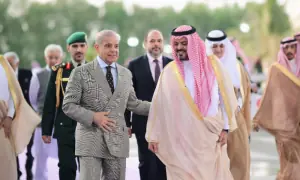
And while the government gave up its reluctance to keep the agreement under wraps, the Sharifs themselves have also changed their position, from categorically denying to have signed any deal or undertaking to finally conceding a few days ago to have left Pakistan in accordance with an understanding with the Saudi royals, and not with the government of Gen Pervez Musharraf. According to observers here, the government’s hesitation in making the agreement public is understandable, particularly because it involves the Saudi leadership at the highest level. And Saudi Arabia rarely says anything publicly about its behind-the-scene role in any dealings with foreigners. This has been the main feature of Saudi diplomacy.
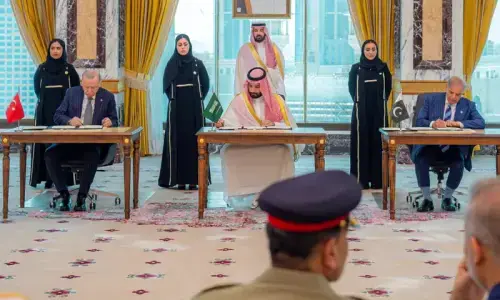
When President Pervez Musharraf landed in Jeddah about a month ago, after his historic sojourn to Abu Dhabi to meet PPP chairperson Benazir Bhutto, he was not accompanied by any foreign ministry official. It was thus evident that his visits to both Jeddah and Abu Dhabi, had something to do with domestic compulsions, rather than any foreign policy objective.
Interestingly, when the president landed in Abu Dhabi, neither the UAE president nor the prime minister was there to receive him, a clear indication that the visit had nothing to do with relations between the two countries.
The purpose of the visits was clear and insiders here suggest that Pakistan’s domestic politics was the main issue on the agenda when King Abdullah bin Abdulaziz met President Musharraf.
There have been reports here of the Sharifs having earned displeasure of the Saudi government on a number of accounts. Senior diplomats have told this correspondent that the Saudi leadership had been expressing dismay over the Sharifs’ conduct while they were in Saudi Arabia. Shahbaz Sharif’s attempt to land in Lahore did not serve to improve their relations with their benefactors.
And some of their recent actions may have further weakened the Sharifs’ case in Riyadh, some insiders believe. They suggest that when the Sharifs were allowed to leave Saudi Arabia after they had pledged to return within a stipulated period and not to take part in active politics ‘as per the original understanding’ of December 2000. The Saudis rarely display their diplomatic displeasure in public. And, therefore, people here were surprised when members of the Sharif family, including Abbas and the mother of Nawaz and Shahbaz were asked to vacate, at a very short notice, the Suroor Palace where the Sharifs had been staying since their arrival in Saudi Arabia. It was evident then that all was not well between the Sharifs and the royal family.
There have been reports that Mian Nawaz Sharif was perturbed by the Saudi demonstration of displeasure and tried to take steps to mend ties with his erstwhile hosts. His close lieutenant Saifur Rahman is said to have been moving around to get the relationship back on track, apparently without much success.
Besides, some knowledgeable people here say, the Sharifs’ decision to sell the land allotted to them by none else than King Abdullah himself for setting up a steel plant near Makkah may also have not gone well with the royal family. The Sharifs sold the land at a high price to a major local business group which, incidentally, also bid for the Pakistan Steel Mills.
Sources in the group maintain that they had paid a hefty amount of Saudi Riyal 75 million to the Sharifs, was just the price for the prime land; otherwise the plant the Sharifs had set up there was ‘nothing but junk’.
The Sharifs had reportedly paid just SR5 million to the Saudi government as token price for the land. This deal may also have irritated the royals here, journalists in Jeddah maintain.
There thus appears to be more than one reason for the current chasm between the Saudi leadership and the Sharifs. And although the local press has not reported anything so far on the issue, reports of serious disappointment of the Saudi leadership with the Sharifs have been doing the rounds here for some time.
And this may have encouraged the Musharraf government to decide to make the exile agreement public, its submission of copies of the document in the Supreme Court of Pakistan being the first step.