0
0

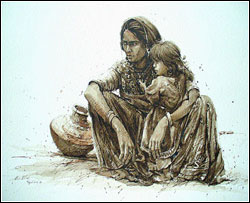 KARACHI: Hyderabad-based artist Ali Abbas, who is exhibiting in Karachi after two years, is still obsessed with the Tharis, particularly the Kohlis. His fascination hasn’t ended. “Why should it end,” he says, “when I am not exhausted, nor is my favourite subject? I need something more powerful to lure me away.”
While his last exhibition at the same venue – Chawkandi Art – only featured watercolours, this time he has acrylic on canvas to display. But Abbas’ command over his lines, or to put it simply his drawing, comes to the fore when he works in watercolour. He employs the modest qalam, the pen which students in rural areas use for writing on the traditional takhti.
Abbas’ works in acrylic is colourful but his drawings are sepia-toned. When asked why he does not portray the colourful clothes of the nomads any more, pat came the reply: “I feel that the nomads are children of the soil, which is why they ought to be portrayed in earthen shades and hues.”
Two years ago, at the same venue, he mentioned that the reason he doesn’t draw the background – the shrubs, huts and the landscape of Thar – is that he has not seen the Tharis in their natural habitat. He has interacted with them in the outskirts of Hyderabad, where these gypsies have camped in large numbers.
What makes them nomads? “Nature is often inhospitable, which is why during long droughts they have to move about in search of greener pastures; but then nature can also be benevolent,” says the artist. “On the other hand, the feudals’ attitude towards them remains unchanged. They exploit these poor and defenceless people in different ways, leaving them with no choice but to shift to safer places.”
Abbas’ recent work in acrylic uses the motifs of their dresses and peacocks, which are common in Tharparkar, in the background. A case in point is his composition depicting Sumar and Ganga, two real characters who were persecuted by the local wadera.
Their love story is as powerful as the tales of legendary lovers such as Laila-Majnoon and Shirin-Farhad. They were lucky, however, to finally unite after their ordeals.
The artist’s depiction of a faded rilli offers another social comment – it symbolises the fading away of a rich culture.
Ali Abbas teaches art at the Sindh University in Jamshoro and at the Khana-i-Farhang Iran. Undeterred by the heavy rain, the 39-year-old artist drove from Hyderabad to attend the opening reception of his show.
He was accompanied by his supportive wife and 10-year-old son, who was more interested in the remote control car in a toy shop close to Chawkandi Art than in his father’s exhibition.
Worth a visit, the show will continue until August 14.