0
0

LAHORE, June 15: The Punjab government proposes to issue municipal bonds to raise Rs6 billion during the next financial year, says Punjab Planning and Development Board Chairman Suleman Ghani.
Answering a question at the post-budget press conference on Friday about a hefty increase in the province’s debt stock as a consequence of loans obtained in the last four years from multilateral donors, Mr Ghani said the government was borrowing to finance development of social and production infrastructure to create jobs and alleviate poverty.
The provincial debt stock, according to Finance Minister Hasnain Dareshak, has grown to Rs266 billion from Rs150-160 billion since the formation of the incumbent government in 2002-03.
The minister said the government had borrowed money from multilateral donors to support its development initiatives in the province and retire its expensive federal cash development loans (CDL).
He said the province had already retired a CDL stock of around Rs17 billion in the last three years and proposed to pre-pay another Rs6 billion during the next fiscal year.
He said it was being done under the provincial debt management strategy to create fiscal space for development. Premature debt retirement had created a space of Rs8 billion in three years, he said.
Mr Ghani said the government was proposing to issue municipal bonds not because it needed money, but because it wanted to enter the domestic money market.
He said infrastructure projects like the Lahore Rapid Mass Transit System required huge funds.
He said the project would cost over $8 billion, adding that the government would raise $1.4 billion from the Asian Development Bank and $1 billion from the market for the first phase of the project.
He said the project would be completed on a built-operate-transfer (BOT) basis and would generate sufficient returns to pay back loans obtained for it.
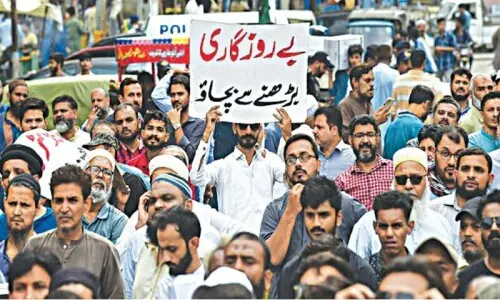
The minister said the unemployment rate in the province had come down from 8.51 per cent in 2002 to 5.65 per cent in 2007, while poverty had reduced by 13 per cent to 21 per cent, meaning at least nine million more people have been brought above the poverty line. He said the government had initiated relief programmes like the cash income transfer scheme, land grant scheme and the microfinance for the poor.
He said these measures were being taken to support the poorest of the poor as growth did not affect everyone uniformly. “It is the duty of the government to help and support the poorest segments of society, which form 6-7 per cent of population, and try to extricate them from extreme poverty,” he said. He said the provincial government would shortly start five small hydropower projects.