



 0
0

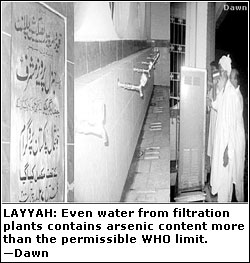 LAYYAH, June 11: The underground water of Layyah, which was considered to be the best in south Punjab some two decades back, now contains high arsenic content to such a dangerous level that every 10th citizen is reportedly infected with water-borne diseases.
Besides, the potable water supplied by the tehsil municipal administration is also unhygienic and unfit for human consumption due to the mixing of sewerage water. While the drinking water being supplied through purification plants in Layyah, Kot Sultan and Chowk Azam is also contaminated.
A survey revealed that the sub-soil water, with the passage of time, receded perilously that caused the addition of arsenic content, bacteria and other germs to a dangerous level, much more than the set international standards.
The use of contaminated water in Layyah has resulted in the increase of diseases, like gastroenteritis, cholera and hepatitis A.
In 2003, the Unicef had carried out the laboratory test of underground water to determine the standard of its quality. The 1,113 water samples collected from various parts in the Layyah tehsil had indicated that the underground water contained high arsenic concentration and bacteria viruses. Some samples had more than 500 Part Per Billion (PPB) of arsenic value as against the World Health Organisation’s standardised value of 50 PPB.
It may be mentioned that the tap water, which is being provided to only eight per cent population in the district through water supply schemes, is highly contaminated and unfit for human consumption.
Laboratories of Islamabad have, after the detection of germs and arsenic content in samples, already declared harmful the potable water of the purification plants installed recently on College Road, Chowk Azam and Kot Sultan by the TMA.
The report further indicates that the sub-soil water in Hospital Colony, Wahdat Colony, Sugar Mills Colony, TDA Colony and Hafizabad contains bacteria virus and arsenic content more than the WHO’s standard.
A survey of these localities reveals that water supply pipes were laid side by side with the sewerage lines decades ago. Now the rusted pipes are ruptured from various places that allow the sewerage water to mix with the drinking water causing water-borne diseases.
Dr Zaffar Iqbal Malgani of the DHQ Hospital said that the people should use boiled water to steer clear of water-borne diseases, like gastroenteritis, cholera and jaundice. He said the government should also launch an awareness campaign about the water-borne ailments.
TMO Abdul Majeed Haidrani said that efforts were being made to provide clean drinking water to the public.
He said the projects to provide pure drinking water to the people in Municipal Park and TDA Colony had already become functional while Jinnah Colony and Housing Colony would soon have the similar facility.
Mr Haidrani said that 194 water connection holders of the TMA were paying Rs15,300 annually while the TMA had to foot the bill of Rs120,000 for electricity motors.
He further said that the housing department was establishing water-testing laboratory to facilitate every citizen to get the water tested for his entire satisfaction.
For the supply of arsenic-free water, the TMA would soon install filters at the water purification plants, he said.



























