0
0

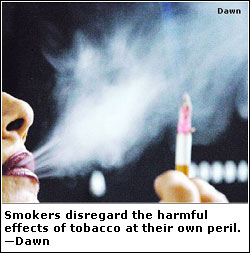 KARACHI, May 30: Like elsewhere across the globe, World No-Tobacco Day will be observed on May 31 in the city where health practitioners will highlight the hazards of tobacco consumption in various programmes planned for the day.
It is felt that the government and other stakeholders have been unable to make concerted efforts against the widespread use of tobacco that causes preventable diseases and death in many cases. Though the rules prohibiting smoking at public places, indoor workplace and public buildings, educational institutions and in public transport as well as sale of tobacco to children exist on paper, they remain largely unimplemented.
According to a senior doctor at Jinnah Postgraduate Medical Centre, cigarettes and other tobacco products have nothing positive. Today tobacco is considered second major cause of death in the world and half of the regular smokers are at the risk of premature deaths.Equally alarming is the fact that hundreds of thousands of people die each year from diseases caused by passive smoking, says a WHO document.
In view of the adverse results of increased public addiction to tobacco, the member states of the World Health Organisation planned a World No-Tobacco Day in 1987 to draw global attention to the tobacco epidemic and preventable deaths. The WHO’s theme for the day is “smoke-free environment” this year.
About the diseases caused to smokers or those exposed to smoke, health experts say it is unfortunate that once a person takes up the first pack of cigarette, he is left with no choice, he gradually becomes addicted to nicotine. Pakistan should exercise an effective control on tobacco products in the country, because it is a signatory to the international convention on the prohibition of smoking, they observe.
Quoting some international findings, an expert says smoking causes 40 per cent of heart diseases and 90 per cent of lung cancers. He says tobacco companies in Pakistan are given a freehand to promote a powerful addictive substance to the population.
According to a study conducted some years back in Karachi, the prevalence of tobacco use was 32.7 per cent. The prevalence of smoking in Karachi has not declined in the past few decades and requires attention of researchers to explore smoking related issues.
A research conducted by students of Aga Khan University Hospital says that 62 per cent of high school adolescents included in the survey reported their reasons for smoking as enjoyment, while 18 per cent claimed to have been influenced by advertisements. Majority of them (61.3 per cent) started smoking with their friends. Boys who spent most of their leisure time outside their homes were more prone to smoke cigarettes, adds the research report.
A community-based study, undertaken in 2005, about awareness and practices regarding tobacco consumption and passive smoking in Gadap Town says that high proportion of people smoked and other people who lined with them shared the environment as passive smokers. The study shows that only 22 per cent individuals were aware of the adverse effects of passive smoking. A total of 157 subjects were studied of whom 110 (70 per cent) were tobacco consumers. In this group, 42 per cent chew tobacco in betel leaves, 39 per cent smoke cigarettes and 19 per cent hookah. About 89 per cent people started use of tobacco under 20 years of age and the reasons given for adopting this habit were social peer pressure (64.5 per cent), depression (22.7 per cent) and pleasure (12.7 per cent).
These statistics and other relevant studies though help chalk out a comprehensive plan to spread awareness among youth regarding adverse effect of smoking, the authorities fail to implement the same in letter and spirit.
Chest physicians, pathologists, ENT specialists and members of medical practitioners’ bodies and the civil society forums have long been voicing their concern over the increasing trend of smoking. They stressed the need for discouraging smokers, particularly children and teenagers.
The Prohibition of Smoking and Protection of Non-smokers’ Health Ordinance was promulgated in 2002 under which smoking at workplaces or in public transport was banned. The aim was minimising the effects of smoking on non-smokers’ health, but defiance could never be averted as one can see even students smoking in the school and college premises.
The executive officer for college education had issued a letter in March 2005 informing the head of institutions of colleges, higher secondary schools and technical education institutions that their institutions had been declared as no-smoking zone. The heads and principals were told that storage, sale, distribution and use of drugs, cigarettes, gutka, supari and any other material or substance considered injurious and hazardous to public health had been prohibited in the government education institutions. Ironically, smoking besides students is common even in the ranks of teaching and non-teaching staff in government institutions.
A provincial government’s anti-smoking task force in February 2007 had also resolved that there would be a complete ban on the sale of cigarettes in educational institutions and its surrounding areas. In line with the anti-smoking ordinance, the task force decided that the CCPO and other senior officials would be urged to cooperate in the implementation of the decision.
Regarding effectiveness of tools against the ban of smoking at public places and transport, a source in the provincial health department said the task force on curbing smoking was reactivated three and a half months back, but things could not go beyond a meeting involving high-ups from various departments and agencies.