PESHAWAR, April 14: The Kurram Agency is on fire again. Fighting between the so-called sectarian groups has been continuing for six days, leaving dozens of people dead or wounded.
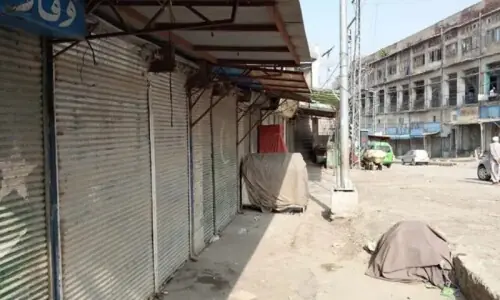
The exact number of casualties is yet to be known, but hospitals are littered with the injured and the landscape is scorched with burnt down houses and shops.
Over half a million inhabitants of this otherwise peaceful tribal agency have been facing difficult circumstances for the last one week.
For almost a decade, followers of different faiths and religious sects had been living in perfect harmony. The administration, with the consent of tribal elders, had banned public display of weapons in the agency some time ago, making Kurram the only weapons-free tribal agency in the tribal belt.
But all of a sudden the region has been thrown into a tailspin of violence and just like in the past, the episode is being described as sectarian conflict.
But there may be more to it than meets the eye.
Created in 1892, the Kurram Agency is the second largest tribal region after South Waziristan Agency.
Surrounded by lofty mountains, the agency is bordered by Afghan territory on three sides. Parachinar, the agency’s headquarters, is just about 90 kilometers from Kabul, the capital of Afghanistan.
During 1980s, the agency served as a major staging point for Afghan guerillas to put pressure on Kabul. It also saw the influx of Afghan refugees, upsetting the demography of this region.
While sectarian riots on smaller scale had hit the region as far back as 1963, major riots broke out in mid-1980s, and again in 1996, amid growing influence of Islamic fundamentalists in the area.
On these occasions, the message for Kabul was an ominous one.
In 1981, the Pakistani tribal region embarked on a course of history that brought a war of attrition to Kabul and introduced a culture of drugs and guns in Pakistan.
In 1996, the violence preceded the Taliban’s final run to capture Kabul and start a tragic era in the Afghan history that culminated after the US-led invasion of Afghanistan after the 9/11.
The latest spate of violence sparked off first in Parachinar and spread like jungle-fire across the area.
Apparently, objectionable slogans raised by some elements during a religious gathering fuelled the crisis. Surprisingly, the hostilities started when Sunnis and Shias were holding a joint gathering in the city.
Local people say tension had been simmering in the area since the peace deal in North Waziristan which sent many Waziristan-based Taliban fighters to cross over into Afghanistan from the Kurram border.
This was resisted by Kurram elders who said they felt threatened by armed militants in a situation when Kurram tribesmen were not allowed to carry weapons.
Many local people suspect a “hidden hand” in sparking trouble in the name of sectarian riots because grounds for such a conflict have not existed in recent years.
They say there are long-running local disputes over the ownership of property and forests, and clans may have trouble with each other over distribution of irrigation water, but sectarian animosity does not have deep roots in the region.
So how do we explain the recent violence?
Absence of good governance and lack of accountability of officials are some of the reasons undermining the state structures all over the country, more so in the tribal areas.
The Frontier Crime Regulations, the law under which the tribal areas have been regulated since 1901, has become a tool of exploitation in the hands of officials but no efforts seem to have been made to reform or replace it. As a result, injustices have prevailed in the tribal areas and there is no effective mechanism in place for grievance handling.
But most important of all, a culture of “warlordism and Lashkar” is being systematically promoted by the rulers, thereby undermining the fundamental values, customs and codes of the tribal society that were once central to peace and harmony in the region.