



 0
0

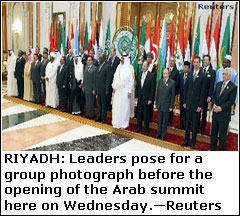 RIYADH, March 28: Arab leaders meeting in Riyadh on Wednesday unanimously decided to revive a five-year-old plan for peace with Israel and launch a diplomatic offensive to resolve the Middle East conflict.
A resolution reaffirming their commitment to the Saudi-inspired peace plan was adopted by the Arab League heads of state on the first day of their annual summit in the Saudi capital.
The blueprint offers Israel full normalisation of relations if it withdraws from all land occupied in the 1967 war and allows the creation of a Palestinian state and the return of Palestinian refugees.
In the resolution, Arab leaders `reaffirm the commitment of all Arab states to the Arab peace initiative as approved at the Beirut summit in 2002 in all its elements’.
They also `reaffirm their call to the government of Israel and all Israelis to accept the Arab peace initiative and seize the opportunity to resume the process of direct and serious negotiations on all tracks’.
But the appeal met only a guarded welcome from Israel, which recalled that there were elements of the peace blueprint, for instance on the right of return of Palestinian refugees, that were unacceptable to the Jewish state.
“We need to take our time studying what has happened at this summit before taking an official position,” an aide of Prime Minister Ehud Olmert said.
“We are studying the text of this initiative in detail to establish if there is anything new, if there are any changes,and when we've done that, we will react officially,” said Mr Olmert's spokeswoman Miri Eisin.
Egyptian Foreign Minister Ahmed Abul Gheit said the heads of state adopted all resolutions submitted by their foreign ministers, including relaunching the peace plan.
The annual gathering comes after US Secretary of State Condoleezza Rice appealed to Arab states to `begin reaching out to Israel’ by building on the 2002 plan.
Saudi Foreign Minister Prince Saud al-Faisal warned in an interview with a British newspaper that Israel should not expect any further diplomatic overtures.
“If Israel refuses (the plan), that means it doesn't want peace and it places everything back in the hands of fate.
They will be putting their future not in the hands of the peacemakers, but in the hands of the lords of war.”
A US push for peace has been complicated by the formation of a Palestinian unity government including both Hamas -- boycotted as a terrorist group by the West -- and the secular Fatah party of President Mahmud Abbas.
Mr Abbas warned Israel on Tuesday: “If this initiative is destroyed, I do not believe that a better chance for peace will present itself in the near future.”
But Prime Minister Ismail Haniya said: “I don't expect at all that Israel will accept the peace plan.” Syria will host the Arab summit next year, the heads of state decided.
ISRAELI ACTIVISTS: Dozens of Israeli peace activists rallied on opposite Prime Minister Ehud Olmert's office on Wednesday, calling on him to adopt the peace initiative drawn up by Arab states.
More than 100 protesters brandishing placards reading “Support the Saudi peace initiative” and flags from Arab states gathered outside Mr Olmert's office.—AFP




























