0
0

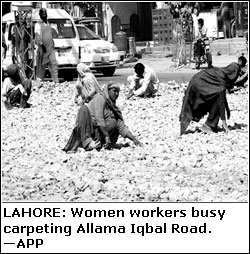 IS it time for the women of Pakistan to celebrate the International Women’s Day, falling on March 8, for gender parity? Politically visible Pakistani women are, in terms of representation, but are they ‘empowered’?
In one of its daily reports, the Council on Foreign Relations, a US based resource for non-partisan information and analysis, noted on March 1: “Zille Huma Usman’s death and the new bill (Prevention of Anti-Women Practices Bill) highlight the paradoxes of gender inequality in Pakistan ... violence against women remains an endemic problem in Pakistan.”
For an average woman of this country the beating of the emancipation drum sounds no more than cacophony. On January 27, the 16-year-old Nasima, who belonged to Habib Labano, a village 525 kilometres northeast of Karachi, was kidnapped and gang raped and forced to walk back home stripped of her clothes.
Similar to the pattern followed in the case of Mukhtaran Mai, who was gang raped in 2002 under decree from a panchayat. Had the accused in Mukhtaran’s case been prosecuted by now, Nasima’s violators might not have repeated the act, or at least the law enforcers and society at large would have viewed it differently. After collecting data on reported cases, the Human Rights Commission of Pakistan states that, “a woman is raped every two hours and gang raped every eight hours”. These figures certainly do not provoke celebration.
The report claims that in 2006 at least 565 women and girls in Pakistan were killed in the name of honour, which was twice the number recorded in the previous year. According to the report, 475 of last year’s honour killings were a result of accusations of ‘illicit relations’. Sixty of the dead were minors. The government arrested only 128 people.
Women’s issues are used for political leverage to gain electoral and international validity. The Women’s Protection Bill, declared as the Magna Carta of women’s liberation, and the Prevention of Anti-Women Practices Bill, moved in the National Assembly on February 13 by PML president Chaudhry Shujaat Husain, would have been prioritised much before the impending general election. How can women take the government’s women-friendly overtures in earnestness when the Punjab chief minister does not even show up at the assembly session for condolences offered by the treasury and the opposition at the murder of his cabinet minister, Zille Huma?
Ms Asma Jehangir, lawyer and activist, recently ‘accused the government of using the Women Protection Bill to improve its image abroad while failing to tackle widespread violence and discrimination against women at home’. She was quoted as saying: “There are two faces of the government. One face is for the diplomatic enclave (in Islamabad). The ugly face is for the women of Pakistan and I’m sorry that we see that ugly face much too often with every case that comes before us.”
Figures released by the Interior Ministry of Pakistan say “there have been more than 4,100 honour killings since 2001.” The controversial application of the Qisas and Diyat law provides immunity to the practice of ‘honour killings’. The law allows the next of kin of the victim to forgive the murderer in exchange for monetary compensation.
The Lawyers for Human Rights and Legal Aid (LHRLA), a non-government organisation, has compiled a report on the state of women in Pakistan and claimed an increase in violence, trafficking, murder and torture of women. The report states that in 2006 there were 7,564 reported cases of violence against women in the country. There were 1,993 cases of torture, 1,271 women were kidnapped and 792 women were killed in the name of honour. As many as 822 women committed suicide in 2006, 259 were gang raped, 119 were trafficked and 144 booked under the Hudood laws. The count of crimes against women is probably much higher than the figures quoted in the report because a huge number remains unreported.