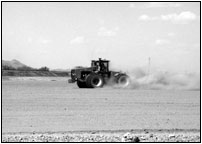
 THE decision of the Punjab government to provide laser land levelling technology in every union council aimed at curtailing wastage of irrigation water in the province is a good move for the farming community. Considerable quantity of water is lost during irrigation due to uneven fields and poor farm designing owing to unlevelled fields. It is estimated that about 20-25 per cent water is lost during field application in the form of evaporation and leaching thus affecting the irrigation efficiency.
There are numerous factors of depletion of soil fertility and productivity. Among others, unlevelled fields cause significant loss of fertiliser nutrients in the process of leaching. Irrigation water and rainwater flows toward low lying areas along with nutrients and subsequently moves downward. Resultantly, fertiliser use efficiency is considerably lower in the cultivated fields. Irrigation water that is crucial input for raising crops is wasted contributing to poor irrigation efficiency as well. Uneven field become less productive compared to levelled fields. Unlevelled fields also give rise to salinity and water-logging problems.
In this context, levelling of fields is essential to maintain soil fertility and productivity and to save irrigation water. Under the devised programme, the Punjab government would provide 2,500 laser sets in irrigated areas for the development of agriculture sector. Another important feature of the programme is the involvement of the private sector. Public-private joint venture would not only improve service delivery in this field but also contribute to capacity building of farmers and operators for sustainable transfer of technology to the farmer community.
It is estimated that the provision of laser units to farmers under the programme would help curtail irrigation application losses up to 50 per cent. Besides, about 7.5 million acres within a period of 10 years will lead to cumulative water saving of about 5.62 million acre feet. It is an important step towards conservation of water and land resources essential for sustainable agriculture and food security.
Statistically, the programme will help enhance crop yield by 20 per cent, control of water-logging and salinity, facilitation in efficient use of agricultural machinery and productive utilisation of seed, fertiliser and other non-water inputs. Levelled fields ensure uniform germination of seed. Cultural practices like hoeing, weeding, spraying and harvesting become easier when crop plants are of equal heights. Pre and post harvest losses are also minimised if crop matures uniformly.
Judicious use of inputs viz. fertilisers, irrigation, seed, pesticides etc. is essential to bring down cost of production. And levelling of fields would help optimise use of these inputs and thus would contribute to lowering of cost of production.
The Punjab government has set following main objectives to achieve from this programme: to increase agricultural productivity by optimising land and water resources; to conserve land and water resources; to develop private enterprise in rural areas, to provide agriculture services especially laser land levelling; to enhance cultivated area by reducing dikes and ditches; to reduce production cost by increasing cultivation efficiency and minimising labour for irrigation and to alleviate poverty in rural areas through better farm returns and employment generation.
By levelling of fields, crop harvest could easily be enhanced that is much lesser presently owing to a number of constraints, mainly shortage of irrigation water. It is because unlevelled fields causing wastage of land and irrigation water could be efficiently utilised. Increased farm produce would help to alleviate rural poverty that is endemic. Moreover, land levelling would help in minimising the cost of operation, ensures better degree of precision in much lesser time and save irrigation water.
About 82 per cent of farming community consists of small farmers. Accessibility of land levelling laser technology to small farmers is as essential as to large farmers. Depriving small farmers from this facility would not help achieve the desired results.
Almost 22 per cent of the gross domestic product (GDP) comes from the agriculture sector. Crops are cultivated in irrigated as well as rain-fed areas. However, irrigated farming is most important. Some 18.78 million hectares of total 22.94 million hectares cropped area is irrigated. The main sources of irrigation water are canals and underground water pumped through tube-wells.
The Indus Basin Irrigation system is the world’s largest integrated irrigation network that comprises three large water reservoirs, 19 barrages, 12 inter-river link canals, 43 irrigation canals including perennial, annual, flood and over 107,000 watercourses.
The total length of canals is around 61,000km whereas watercourses and farm channels measures 1.6 million kilometres. The system drains an average of 106 MAF of surface water each year for irrigation purpose. It is supplemented by 43 MAF ground water pumped by means of tube-wells per annum. But conveyance and distribution efficiency is dismally poor. Water losses occur in huge amount in the form of seepage, percolation and overflow. The government is well aware of the water-related problems confronted by agriculture sector.
Seemingly, the government has earmarked Rs66 billion for development of water courses that is successfully under way. Lining the watercourses would reduce seepage of water and thus would prevent salinity and water-logging of fields. Decision to provide land levelling laser technology is another step towards development of farm sector. The need is to implement the programme in letter and in spirit.