0
0

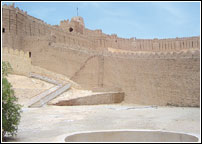 KOTDIJI (Khairpur), Jan 17: The federal government has stopped the shoddy restoration work on Kotdiji, one of the many historic forts in Sindh protected under the Antiquities Act 1975, following reports that cement was used in place of original building material still available in abundance, it has emerged.
Like Ranikot, Kotdiji has also fallen victim to ill-planned restoration work carried out by officials unacquainted with the principles of conservation as laid out in the famed manual of veteran archaeologist Sir John Hubert Marshall, director-general of the Archaeological Survey of India from 1902 to 1928.
The government decision came following the visit of a senior official of the federal archaeology department to the Khairpur district fort, who discovered, much to his horror, that in addition to the use of cement, a concrete staircase had been built that snaked its way from the main gate to the third gate of the fort.
Sources said the “restoration project” was being carried out by the Khairpur district government – a charge stoutly denied by the Khairpur nazim – under a project sponsored by the Sindh culture department.
Conservationists maintain that an inquiry be immediately instituted to determine how three government departments – the federal archaeology department, the Sindh culture department and the Khairpur district government – allowed “non-technical people” to go ahead with the restoration project.
They take issue over the use of cement in place of original building material – in this case, burnt brick tiles in mud mortar, lime stone, etc as used by the Talpur rulers of Khairpur – which is still available in abundance. They point out that the modern staircase sticks out like a sore thumb.
The sources recalled that the Khairpur district government – then headed by nazim Nafisa Shah – had asked the federal archaeology department for assistance in the restoration of the fort. They added that senior official Mohanlal Ochani was sent to the fort who prepared a dossier on Kotdiji’s conservation.
“But the recommendations of the federal archaeology department were not followed,” they said.
The sources said a ring wall around the well in the fort had been constructed with cement, which had also been used on the battlements.
“A water pipeline has been laid above the ground. Electricity poles have been erected outside the fort and plans were afoot to erect the poles inside the fort. A new room has been constructed inside the fort for the watchman,” they said.
The sources added that while a vertical damp-proof course had been laid at the fortifications, damp seemed to have risen from the ground.
They said the archaeology department’s Sindh and Balochistan chief, Qasim Ali Qasim, had written a letter to Khairpur Nazim Pir Niaz Hussain Shah and pointed out that the conservation plan prepared by Mr Ochani had not been followed.
Mr Shah responded by saying that the Khairpur district government had not carried out the Kotdiji restoration work and had actually been protesting over its “defacing” by the executing agency. However, he did not spell out who the executing agency was.