0
0

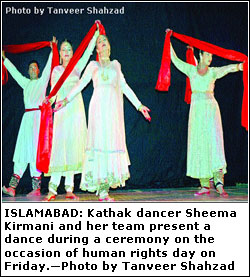 ISLAMABAD, Dec 8: No one could have depicted violence against women so vividly as did the famed Kathak dancer and social activist Sheema Kirmani in a dance featuring Fehmida Riaz’s poem Ao ae hum vatano raqs karo raqs karo (Let us dance) at the National Library on Friday evening.
The show was jointly hosted by the United Nations, the Oxfam, the Interagency Gender and Development Programme (INGAD), and the Swiss Agency for Development and Cooperation (SDC) to celebrate the UN Human Rights Day. This year’s theme is “Fighting Poverty — a matter of obligation, not charity”.
The focus of the dance and the tableau presentation by children was on poverty and violence against women. Sheema Kirmani realistically dramatised the oppression of women in our society. Her white Moghul costume from the 16th century and a sharp musical cry Oh God, please don’t create me in the shape of woman brilliantly illustrated the theme.
The artists presented many dance scenes and music, each depicting different forms of violence against women, and the cloistered feeling diminishing their creative potential. But in the last scene the woman was dancing with joy because the society supported her cause and voiced for her well being.
“Woman finds joy when the poor of the earth joins her dance to support her creative excellence”, said Sheema.
Earlier, the Grammar School, Rawalpindi campus students presented a tableau based on two poems by the legendary great Faiz Ahmad Faiz, Mati se utho mere lal (Rise from the dust, my child), and Yeh haath salamat hain jab taak.
The children depicted Faiz’s invocation to the poor people to break away the shackles of poverty and struggle against fear and deprivation and for freedom.
As it is, the great poet cries out in his poetry seeking power for the poor and to proclaim that God wished justice and equality from a warped world that denies fundamental freedom to the downtrodden.
The audience lent a good hand for the small children who had acted out the poet’s philosophy so well with outstretched hands trying to grasp the feeling of liberty.
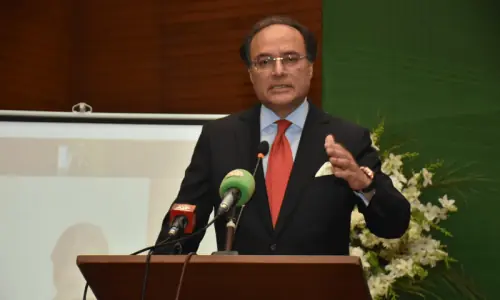
Parliamentary Affairs Minister Dr Sher Afghan Khan Niazi, gave away prizes to eight children for winning the essay competition sponsored by the UN Information Centre.
The first prize was won by Rahila Mumtaz of the Islamabad Model College for Girls, F-6/2; second prize went to Sadaf Jamil of the Federal Government Margalla College for Women, F-7/4 and the third prize was bagged by Ahmad Mursaleen of the Islamabad Model College for Boys G-10/4. Majid Yaqub, Reema Hafeez, Zile Huma, Shamil Ibrar, and Nimra Sultan received consolation prizes.
Speaking on the occasion the minister said that one of the best ways of reducing poverty was to abandon the manufacture of weapons of mass destruction.
“Every one should be treated as equal in the world and if the super powers were sincere in eradicating poverty they must get down to distributing plenty to the poor people of the world.
The minister also exhorted men to respect the women.
A panel of judges — Zafar Abbas, Dr Nazir Husain, and Tetsuo Maximilian Ohno, UN Information Centre Director — screened the essays and announced the names of the prize winners.
Oxfam’s country director Farhana Faruqui-Stocker opened the proceedings stressing that proper dignity should be shown to the women.
Ms Najma Saihgal also spoke on behalf of her organization, the INGAD.—Jonaid Iqbal
PPI adds: Students from the schools and colleges of Islamabad and Rawalpindi participated in the essay contest under this year’s theme.
A large number of entries were received from 16 schools and colleges, which represented high quality of works by students.
The Interagency Gender and Development Group is composed of 30 bilateral and multilateral donor agencies working on gender issues in Pakistan.
The INGAD supports the efforts of the government to mainstream gender in policies and programmes at both federal and local levels. It also networks with NGOs, civil society, research organisations and gender advocacy groups to share best practices in addressing gender disparity.