0
0

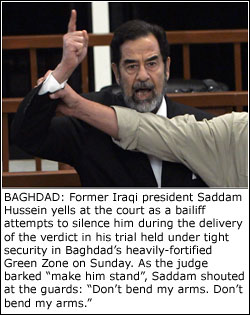 BAGHDAD, Nov 5: An Iraqi court expectedly sentenced a shaken but defiant Saddam Hussein to death by hanging on Sunday for crimes against humanity, driving a wedge between the strife-torn country’s embattled Shias and Sunnis and dividing the Arab world right down the middle.
Defying a curfew imposed by the government of Prime Minister Nuri al-Maliki in anticipation of a sharp spike in sectarian riots following the announcement of the much-awaited verdict, both Iraqi Shias and Sunnis poured on to the streets and fired into the air -– the former, in jubilation; the latter, in anger.
The Arab world was bitterly split over the death sentence against the former Iraqi leader, with some praising the verdict as heavenly justice but others, sharply critical of the United States which set up the court after its controversial invasion toppled Saddam in 2003, describing the trial as “victor’s justice”.
Saddam was convicted over the killing of 148 people in the mainly Shia town of Dujail following an assassination attempt on him in 1982.
His half-brother, Barzan al-Tikriti, and Iraq’s former chief judge Awad Hamed al-Bandar were also sentenced to death.
Former vice-president Taha Yassin Ramadan got life in jail and three others received 15-year prison terms.
Another co-defendant, Baath party official Mohammed Azawi Ali, was acquitted.
Sixty-nine-year-old Saddam, dressed in his usual dark suit and white shirt and carrying the Quran, initially refused to stand when brought in to hear the verdict from Kurdish chief judge Raouf Rasheed Abdul Rahman at a quickfire, 45-minute hearing. When he did, shakily, with clear emotion, he yelled the defiant Arab battle cry “Allaho Akbar!” and “Long live Iraq” as the judgment was read.
Earlier, addressing the judge, he said: “I’m Saddam Hussein, president of Iraq. I am above you and above your father.”
When the judge asked him to identify himself, the former Iraqi leader said: “First of all, who are you? What are you? I want to know who you are. Are you judges?... I don’t have anything against any of you. But adhering to the truth and respecting the will of the great Iraqi people in choosing me, I say: I do not respond to this so-called court, with all due respect to its people, and I retain my constitutional right as the president of Iraq.”
Kuwaitis, who suffered a seven-month Iraqi occupation in 1990-91, applauded the Baghdad court’s decision, and a foreign ministry spokesman of Iran, which fought a war with then US-backed Iraq from 1980 to 1988, said his country welcomed the verdict.
There was widespread sympathy for Saddam, however, among Palestinians who had admired him for defying the United States and for firing missiles at Israel in the 1991 Gulf War.
Elsewhere in the Arab world, reaction was muted, even though many view Saddam’s trial as a US-orchestrated mockery.
“Any trial conducted under occupation is illegitimate,” Syrian Information Minister Muhsin Bilal told reporters in Damascus.
Predictably, the United States, where capital punishment was reintroduced in 1976, called it a good day for Iraq.—Agencies