0
0

EREZ CROSSING (Gaza Strip): Looking somewhat stiff in his suit and carrying a small suitcase, William Tarazi passes the final control check separating Israel from the Gaza Strip with a smile: “Eidul Fitr is an eagerly awaited day — the only one during the year to visit my family.”
Like hundreds of other Israeli Arabs, the 47-year-old businessman came to the Erez checkpoint on Gaza’s northern tip to celebrate the feast marking the end of the holy month of Ramazan with his family.
Since late June, when Gaza-based militants seized a soldier and killed two others in a cross-border raid, the coastal strip has been practically sealed off from the outside world.
Eidul Fitr is one of the rare occasions when dozens of Palestinian families, separated by the Israel-Gaza divide, can visit their loved-ones for two or three days.
“My mother has lived in Gaza and me in Al Quds for more than 20 years. I can only see her at this time of the year,” Tarazi says, showing a piece of blue paper to security officials — his precious laissez-passer into Gaza.
“I had to give a ton of details about myself,” he says. “But I managed to get this authorization. It’s only for two days, but at least that’s something. I saw a lot of families on the Israeli side who were turned away.”
Things have changed enormously in Gaza since Tarazi was last here a year ago. The Islamist Hamas movement is in power, the strip is embroiled in its worst ever financial and political crisis, Israeli military operations have not stopped and supporters of Hamas and Fatah clash violently in the streets.
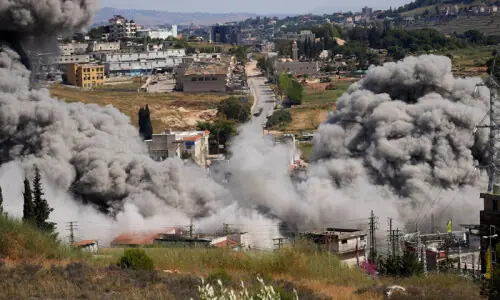
“My heart bleeds at the sight of all this destruction, the fighting, the military operations,” he says, looking at the mounds of rubble that dot the ground on the Palestinian side of Erez — the remains of buildings destroyed by Israeli bulldozers.
In a grim reminder of the continuing violence, hours after he crossed seven Palestinians, including a local militant chief, were killed in an Israeli incursion not far from the checkpoint.
With her two daughters clinging to her long black robe, 38-year-old Mona Naram hesitantly advances in the parking lot on the Palestinian side of Erez, where taxi drivers fight with one another over clients under the bemused gaze of a soft drinks vendor.
“Our life in Israel is easier than that of our families here,” she says. “In Gaza people don’t have money, they don’t have anything. And moreover, the war is unfolding in front of their eyes.”
While at her home in the southern Israeli town of Beersheva, Naram anxiously awaits each day’s news broadcasts.
“Every day, when I hear the news on television or on the radio, I am scared for my mother and brothers who live in Deir al-Balah” in the central Gaza Strip, she sighs, bending down to pick up her bags.
But Rafia Hamdudi, 23, who came with her husband and three children from Lod, near Tel Aviv, refuses to be downhearted.
“It’s true that the situation is difficult for everyone,” she says. “But today is one of the most beautiful days of the year. I will finally see my relatives.”—AFP