Lahore continues to be most polluted city while govt looks ‘the other way’
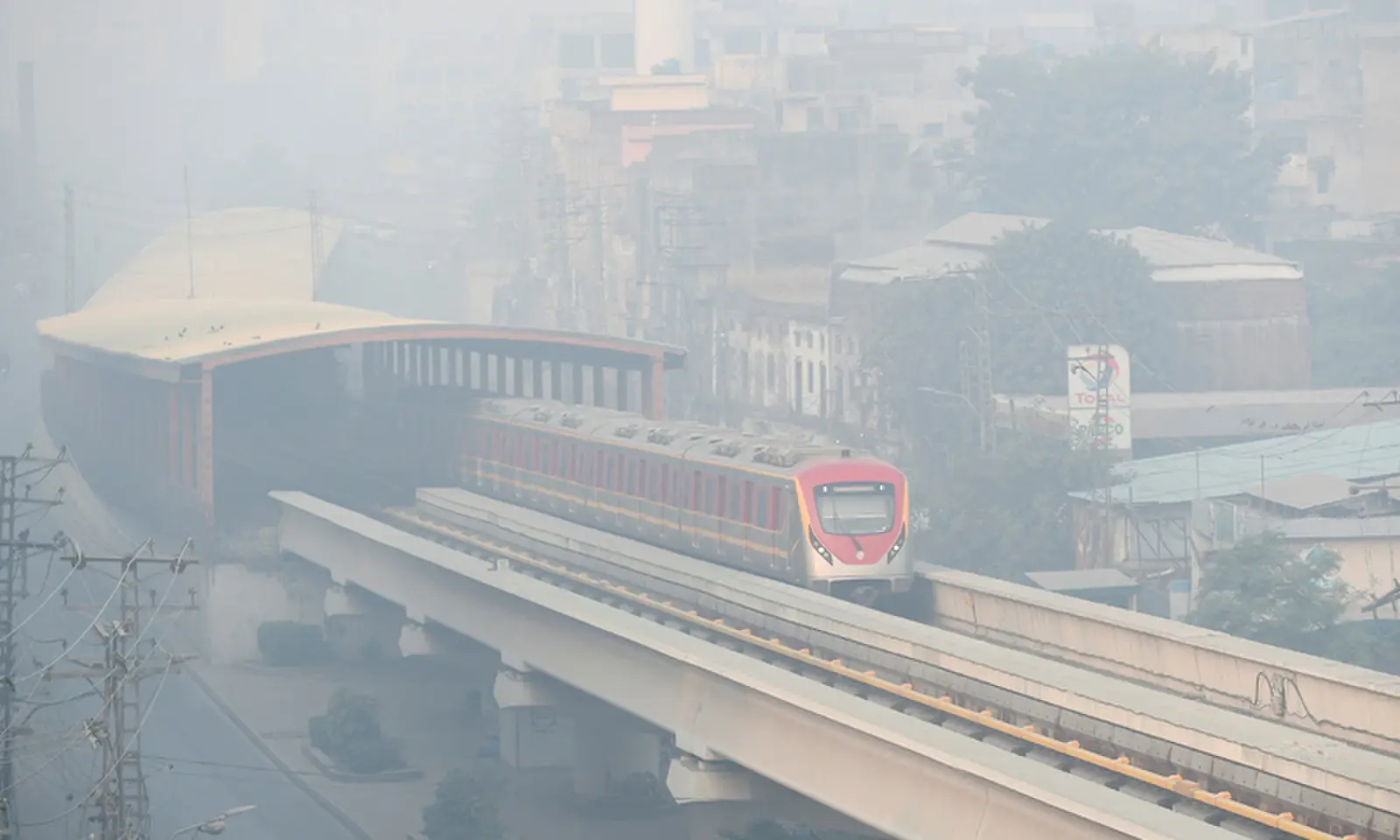
LAHORE: Lahore was ranked the world’s most polluted major city on Monday as its Air Quality Index (AQI) reached 590, according to IQAir. A separate historical reading on the platform, however, showed an hourly index of 647, placing the city in the hazardous category. On the other hand, the Punjab govt as well as its senior minister have hinted at Diwali fireworks in neighbouring India as the cause of rising levels of air pollution.
The IQAir live global major city ranking for 9am to 10am on Nov 9 placed Lahore at the top, followed by Ulaanbaatar (Mongolia) with an AQI of 177, Delhi with 174, Kolkata with 173 and Sarajevo (Bosnia and Herzegovina) with 170.
The ranking showed Lahore’s pollution level to be more than three times that of the second-ranked city. The platform’s historical air quality graph separately displayed an hourly reading of 647 for Lahore during the same period. According to global health statistics, air pollution, both outdoor and indoor, is the second-leading risk factor for deaths worldwide, claiming an estimated 8.1 million lives annually. Outdoor particulate matter alone accounts for 4.7m deaths.
Within Lahore, air pollution is affecting several neighbourhoods. IQAir’s station ranking for the city shows multiple areas experiencing extremely poor air quality. Allama Iqbal Town recorded an AQI of 1,033, while CERP Office 864 and Burki Road/Paragon 748. Hourly historical graphs indicate that pollution levels rise sharply during the early morning and late-night hours, creating dense smog that forces residents to remain indoors.
Govt blames Diwali fires in India; minister claims improvement in situation
The crisis is not confined to Lahore. Other parts of Punjab are also experiencing hazardous air quality. IQAir’s real-time Pakistan city ranking showed Raiwind (688), Multan (655) and Faisalabad (600), all recording air quality levels in the hazardous category.
The deterioration came a day after the Punjab government warned that smoke from Diwali fireworks in neighbouring Indian Punjab, crop-residue burning and easterly winds could aggravate air pollution in Lahore and adjoining districts.
A special report issued by the provincial government on Nov 8 had predicted that smoke from Diwali fireworks could reach Lahore within five to 13 hours. It forecast an increase in pollution levels in Lahore, Kasur and border areas on the morning of Nov 9, as easterly winds were expected to carry polluted air from Indian territory towards Pakistan.
The report identified fireworks, crop-residue burning and stagnant air during the night as factors that could contribute to a deterioration in air quality.
The Punjab government had forecast that pollution levels would remain high on Nov 9 and 10, with a slight improvement expected from Nov 11.
Amritsar, located around 50km from Lahore, was identified as a potential source of cross-border pollution. However, a measurement-based assessment would be required to establish how much of Lahore’s pollution could be attributed to fireworks and other sources across the border.
Indian media reports also highlighted deteriorating air quality after Diwali celebrations in Amritsar, Ludhiana,
Jalandhar and Patiala, the nearest Indian cities to Lahore. The AQI in Mandi Gobindgarh reportedly reached 445 while New Delhi also experienced a sharp increase in pollution following the fireworks.
Later in the day, Punjab Senior Minister Marriyum Aurangzeb said Lahore’s AQI reading had dropped to 208.
“Despite pollution from Diwali fireworks across the border, air quality is improving thanks to the sustained efforts of Punjab government agencies, improved weather conditions, effective smog control operations, better wind speeds and continuous field monitoring,” she wrote on X.
All relevant agencies remain actively deployed in the field, the minister added, urging the public to fully cooperate with enforcement bodies and follow advisories.
As of 7pm, IQAir showed Lahore’s AQI index had dropped to 196, still categorised as unhealthy. The Punjab government’s report recorded 2,347 incidents of crop-residue burning in Indian Punjab up to Nov 4. Of these, 1,081 were reported in three districts — Tarn Taran Sahib, Ferozepur and Amritsar — located opposite Lahore and Kasur. These accounted for 46pc of the reported incidents in Indian Punjab.
However, satellite-based fire detections indicate that agricultural fire hotspots are also a major concern in Pakistan. An analysis by Hamari Hawa using NASA’s VIIRS satellite data recorded 13,241 fire detections in Pakistani Punjab, compared with 3,158 in Indian Punjab, between Oct 1 and 29, 2026, showing more than four times as many detections on the Pakistani side. The analysis found that 92pc of the detections in Pakistani Punjab were on farmland.
A separate analysis covering Oct 15 to Nov 1 identified 7,130 crop-associated fire detections within a 100km radius of Lahore on both sides of the border, including 781 within 40km of central Lahore.
The district-wise figures included 322 detections in Sheikhupura, 149 in Tarn Taran, 106 in Amritsar, 77 in Nankana Sahib, 62 in Lahore and 50 in Kasur. These satellite detections indicate fire activity and should not be treated as individually verified crop-burning incidents.
The Environment Protection Agency (EPA) Punjab, meanwhile, reported 679 agricultural fire incidents across the province, of which 650 had been extinguished through coordinated surveillance and firefighting operations. The agency said it had intensified its crackdown on stubble burning by deploying specialised night squads, drones, tractor-mounted fire bowsers and quick response units in agricultural hotspots.
According to the EPA, the Punjab Climate Watch Hub is using satellite-based fire-anomaly detection to identify vulnerable locations and alert district field formations for on-ground verification and firefighting. The campaign is being conducted in districts, including Hafizabad, Sheikhupura, Nankana Sahib, Faisalabad, Kasur, Sialkot, Sargodha and Gujranwala.
EPA Director General Abdullah Nayyar Sheikh has directed regional directors and field formations to prioritise anti-stubble-burning operations and personally monitor enforcement. He has also conducted surprise inspections along motorway corridors and GT roads to assess surveillance and firefighting arrangements.
The EPA DG said the agency’s operations against agricultural burning were being reinforced through coordination with district administrations and agriculture department officials, while legal action was being taken against those involved in illegal crop-residue burning.
The provincial government’s report also noted that Lahore’s nighttime PM2.5 concentration had already reached 202 micrograms per cubic metre before Diwali. It said prevailing weather conditions had increased the likelihood of pollution from fireworks and agricultural fires accumulating and spreading.
Published in Dawn, November 10th, 2026