THIS refers to the report ‘Residents write to CM Murad, urge halt to reconstruction on Nehr-i-Khayyam’ (Oct 23). The project is truly a classic case study of institutional failure in Karachi.
In his previous stint, the chief minister had announced the rehabilitation of Nehr-i-Khayyam, one of the city’s most prominent storm water drains cutting across the Clifton Boat Basin area. A local non-governmental organisation (NGO) was taken on board in 2019, and the project was expected to be completed in a year. The proposal was to establish a separate line for sewage, which is being dumped into the drain, and then create a public space around it. The project failed.
Subsequently, through the Competitive and Liveable City of Karachi (CLICK) project, a neighbourhood improvement scheme was launched for the Clifton Block 5 area. The World Bank-funded project helped to make new parks, and it also rehabili- tated the area around Nehr-i-Khayyam.
Millions of rupees were invested to construct a pedestrian walkway right beside the drain. A few months later, the current city mayor launched a project related to the dumping of sewage in the drain. Hence, the entire newly-built pedestrian track around the area was destroyed, and Nehr-i-Khayyam again became a construction site. The project was to be completed by June 2026. That did not happen.
Meanwhile, the provincial government claims to be working in Karachi, and continues opposing an empowered local government system or making Karachi an administrative unit, seeming satisfied with the inadequate resources provided to its own mayor. Boasting about his performance by doing the bare minimum — visiting the city while it is being flooded, improving basic facilities like reconstruc- ting some roads, putting paver blocks in some streets, and improving lighting — the mayor often acts ‘surprised’ by the criticism he attracts.
All this while, pollutants and solid waste continue to be thrown around and put to fire on the outskirts of Nehr-i-Khayyam, leaving toxic fumes wafting around resi-dential areas.
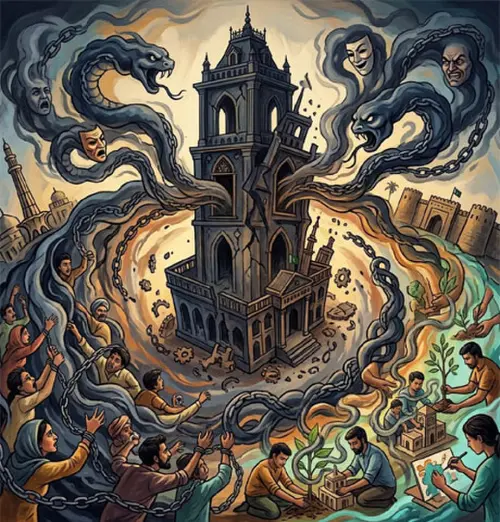
All the money invested to improve the situation has been wasted. These cosmetic activities in an institutionally fractured city are unable to hide deep-seated institutional governance issues, where the provincial government, the local government and the city administration have together failed to execute a simple project that merely involves improving a storm-water drain within a city area.
Mahiba Jaffari
Karachi
Published in Dawn, November 1st, 2026