KARACHI: Eleven Pakistani fishermen, who spent several years in Indian jails for unknowingly crossing over to Indian waters while fishing, were reunited with their families after arriving in Karachi on Friday morning.
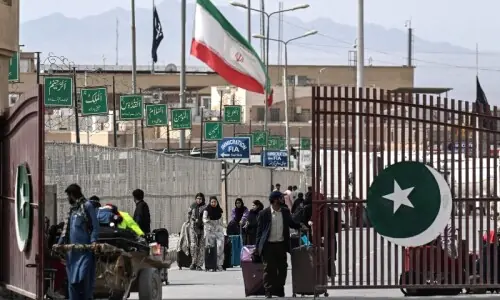
The men were handed over through the Wagah Border by Indian authorities over two months ago. They arrived here at the Edhi Centre near the Merewether Clock Tower by road from Lahore in Edhi Foundation ambulances.
It was a touching reunion where the fishermen, jailed for four years to nine years, finally met their families.
Some, like Kamal Hassan Bengali of Machhar Colony, who was in jail in India for eight years, returned to meet new family members, too, as his eyes grew moist knowing that his mother will not be there to greet him when he gets home.
One of them says he will become a labourer, but won’t go back to fishing again
“The day our boat was captured by the Indian coast guard was the day my mother passed away. I only learned about her passing through a letter which reached me three years later,” Kamal told Dawn, as he held his eight-year-old niece Areeba close.
“I am meeting her [Areeba] for the first time,” he added, smiling through tears.
All of Kamal’s seven brothers and his sister have gotten married in the last eight years. His sister Manzoora told Dawn that with their mother gone, the responsibility of finding a good match for him now fell on her shoulders.
“I will get him married soon now that he is back home,” she said.
Noor Nabi Bengali, also of Machhar Colony, who was also with Kamal on the same boat, recalled their days in Indian captivity with sadness.
“We were given bad food. The lentils and plain rice or the potato and cauliflower curry that we were fed in jail would stink sometimes because it had gone bad,” he said.
Khamiso Siddiq Mallah from Shah Bandar said that he spent almost four years in Indian captivity. Now 60, he said that he has no intention of returning to fishing now that he is back.
“I will become a labourer, but I will never go back to sea,” he said.
Abdul Rehman of Korangi said that he was in jail in India for nine years. “I only remember the horrible jail food and the lonely days I spent behind bars in India. The attitude of the jail staff toward us Pakistanis never let me forget for a minute that we were in an enemy country. They treated us worse than animals.”
Mehboob Ali Mallah of Badin, who was in jail for three-and-a-half years, said that he could not wait to see his children. “My journey doesn’t end here. I still have to travel to my village in Badin. I have three children back home whom I cannot wait to see.”
Basheer of Machhar Colony said that he only knew how to fish, so he could not stop doing that if he wants to earn a livelihood. “But what I’ll do is not ever fish in Sindh. I’ll fish in Balochistan, which doesn’t touch the Indian border,” he said.
“Now that I’m back in my country, I will eat good, healthy food to gain back the 70 pounds that I lost while in Indian jail,” he added.
Meanwhile, Saleem Sabro from Thatta, who has been looking for his missing fisherman brother for five years, came to give Basheer a good look.
“He looks like my brother Ahmed Ali,” he told Dawn, explaining, “I come here whenever Pakistani fishermen return from India to see if my brother might be among them.
“Among the fishermen released last year, I came across one who had information about my brother. He told me that he was in a jail in Ahmedabad,” he shared.
Sabro added that he had in the meantime contacted the Pakistan Embassy in Delhi, the Ministry of Foreign Affairs and the Ansar Burney Trust regarding his brother.
“He served his sentence two years ago, but still he has not returned home. During this time, I have also gotten his two daughters married and found an apprenticeship with a motor mechanic for his young son,” he said.
According to Fatima Majeed Motani, the chairperson of Fishermen’s Cooperative Society, more than 70 Pakistani fishermen are still languishing in Indian prisons after unknowingly crossing into the neighbouring country.
“Similarly, there are Indian fishermen serving time in our jails here. But we treat them far better as we understand that they are innocent people who only crossed over to the other side by mistake,” she said.
Published in Dawn, October 31st, 2026