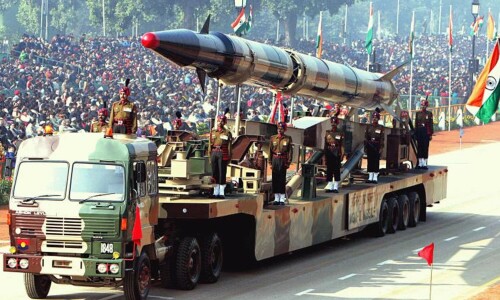
INDIA’S nuclear jingoism was on ample display during Operation Marka-i-Haq in May 2025 when it fired dual-use BrahMos cruise missiles with conventional payload, unmindful of the fact that the dangerous caper could have been misconstrued by Pakistani air defenders as a nuclear attack. Despite an agreement on pre-notification of flight testing of ballistic missiles, the Indians, while testing the Agni V MIRV-capable missile, have shown a blithe disregard for established pre-notification protocols that mandate a 72-hour pre-test notification, a fact pointed out by Pakistan’s Foreign Office in 2024.
While the Indians keep up an implacable momentum of vertical proliferation of nuclear and missile technology, the world indulges them through exceptionalism enshrined in the nuclear waiver for the Nuclear Suppliers Group and membership of the Missile Technology Control Regime.
The Indians have slyly wangled the concession from the USA and IAEA in the civil nuclear deal to keep eight reactors out of IAEA oversight. These pressurised heavy water reactors consume less nuclear fuel than they produce, which can be harvested for strategic military purposes.
It should be remembered that it was the Indians who introduced the nuclear arms race in the subcontinent because of their grandiose big-power pretensions. Their nuclear explosions in 1974 and 1998 forced Pakistan to follow suit out of its security compulsions.
The world indulges India through nuclear exceptionalism.
The Indian nuclear security architecture was provided conceptual ballast by Gen K. Sunderji and Krishna Subramanyam in the 1980s, when they came up with the notion of no-first use of nuclear weapons against a non-nuclear nation, with a caveat of making an exception for biological and chemical attacks. However, India kept developing its conventional forces, especially the armoured and mechanised component, as per the Sunderji doctrine, aimed at tearing Pakistan asunder.
On the geopolitical level the Indians have acquiesced to the status of a regional surrogate to accommodate balancing needs of the US vis-a-vis a rising global competitor, China. While enjoying nuclear exceptionalism the Indians went on a shopping spree for nuclear technology as well as the conventional hardware to operationalise the military strategy that sought an elusive space for conventional wars under the nuclear overhang.
The operational manifestation of these military ambitions was a slew of concepts starting with Cold Start and graduating to proactive operations. The latest manifestation of those concepts is the Dynamic Response Strategy that is based on rapidly deployable all-arms-based integrated battle groups and multidomain-enabled terrain-customised brigade-sized groups called Rudra Brigades.
Pakistan relies on its full-spectrum deterrence, keeping strategic nuclear ambiguity for greater liberty of action to deny India the space for conventional conflict.
While India deploys non-state actors to keep Pakistan destabilised through terrorism, it cleverly conflates Pakistan’s principled support to the victims of Indian state repression in Occupied Kashmir, a UNSC-recognised dispute, with militancy. It has also withdrawn from its international law commitments by illegally holding the Indus Waters Treaty in abeyance and imperilling the food security of Pakistan.
India under the BJP and RSS sway has adopted a foreign policy based upon the antiquated notion of ‘Akhand Bharat’ that covets the territories of neighbours based on historical myths. The inflammatory statement of Prime Minister Narendra Modi at Barmer, Rajasthan, during an election rally that “Indian nukes are not kept for Diwali” indicates a bellicose mindset.
It is against the backdrop of the above facts that the notions of nuclear deterrence in the subcontinent have to be understood. Since the stability of nuclear deterrence is based upon nuclear dialectics between two rational actors, Indian irrationality adds dangerous instability to the nuclear equation.
The deployment of canisterised ground-based ready-to-use nuclear missiles and the submarine-launched nuclear ballistic missiles point to an aggressive nuclear intent when viewed in the context of Indo-Pak distrust and irrationality of the ideologically driven BJP leadership.
The well-known military historian Martin Van Creveld had coined a term for wars in the nuclear era: “Non-trinitarian”, where, unlike Clausewitz’s trinitarian wars, the only political objective would be deterring and not winning the wars.
Whether India has strengthened or reduced its strategic deterrence by fielding shallow-range submarine-based missiles is a point to ponder by Indian nuclear strategists.
The writer is a PhD from NUST.
Published in Dawn, October 30th, 2026